Knee pain is an extremely common complaint in U.S. primary care clinics. This is also common in orthopedic, sports medicine, physical therapy, and pain management clinics. It drives more than 20 million outpatient visits a year.
The challenge for billing teams is that the ICD-10-CM system does not treat knee pain as one code. It breaks it down by laterality, cause, severity, and encounter type. A small misstep, like using an unspecified code, missing the side, or mixing up code types, can cause denials. It can also trigger payer audits and slow reimbursement.
This guide covers the ICD-10 code for right knee pain and related codes. It also explains the documentation needed for clean claims. It outlines common pitfalls and key billing details that practices often ask about. Everything here is general billing education only.
Why Knee Pain Coding Matters for Billing
Accurate knee pain coding affects much more than just one claim line. It influences:
- Medical necessity justification for E/M visits, imaging, injections, and physical therapy.
- Clean claim rate and first-pass payment.
- Risk adjustment for value-based contracts.
- Audit defense when payers question repeat visits.
- Estimate patient costs when you plan imaging or procedures.
When the front end records the affected side. The provider clearly documents the cause. Then, the billing team can choose the most specific code. This is what payers expect.
Also Read: Major Depressive Disorder ICD-10 Codes And Billing Guide
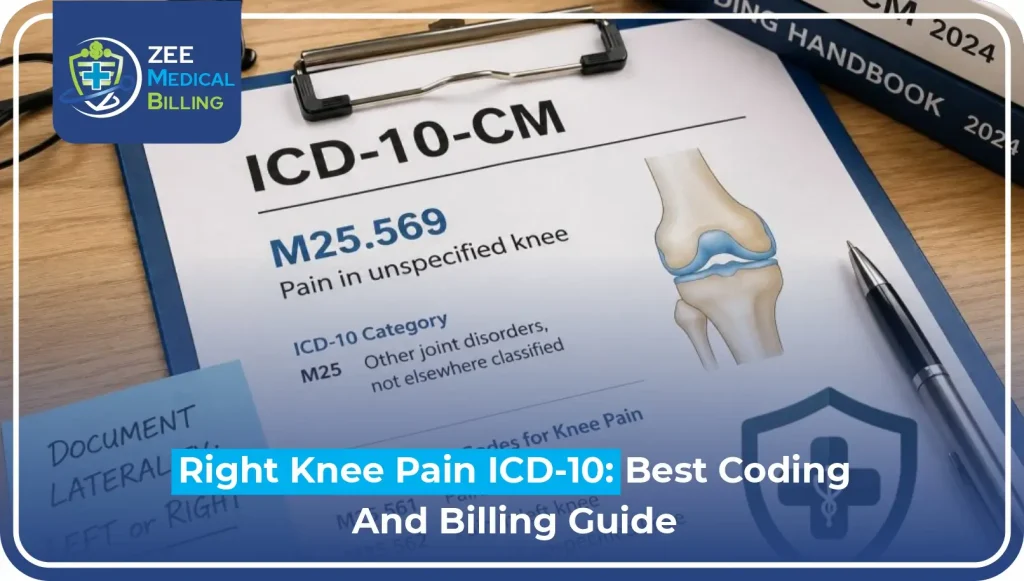
The Right Knee Pain ICD-10 Code: M25.561
The primary ICD-10-CM code for pain in the right knee is M25.561. It sits in the M25.56- family (Pain in knee). It covers localized right knee pain that clinicians have not yet linked to a specific diagnosis.
This includes osteoarthritis or a documented injury.
M25.561 is appropriate when:
- The provider documents pain specifically in the right knee.
- They suspect an underlying cause but have not yet confirmed it.
- The encounter is an initial workup or a follow-up for ongoing right knee pain.
- The visit involves chronic right knee pain without a more specific diagnosis.
A billable ICD-10-CM code. Providers often pair it with E/M codes (such as 99202 to 99215). You may also pair it with imaging orders and physical therapy evaluations.
The Full M25.56- Pain in Knee Code Family
| ICD-10 Code | Description | When to Use |
|---|---|---|
| M25.561 | Pain in the right knee | Right-sided knee pain documented |
| M25.562 | Pain in the left knee | Left-sided knee pain documented |
| M25.569 | Pain in the unspecified knee | Side not documented in the chart |
Many practices get an important note here wrong. Use M25.569 for an unspecified knee when documentation does not specify the side.
It is not for bilateral knee pain. ICD-10-CM does not include a separate combined code for bilateral knee pain in this family. When both knees hurt, the correct approach is to report M25.561 and M25.562 on the claim. Use documentation that confirms pain in both knees.
Right Knee Osteoarthritis Codes: M17.x Family
When the cause of right knee pain is documented as osteoarthritis (OA), the M17.x codes are more accurate than M25.561. Choosing the more specific code matters because OA carries different medical necessity and risk adjustment weights.
| ICD-10 Code | Description |
|---|---|
| M17.0 | Bilateral primary osteoarthritis of the knee |
| M17.10 | Unilateral primary osteoarthritis, unspecified knee |
| M17.11 | Unilateral primary osteoarthritis, right knee |
| M17.12 | Unilateral primary osteoarthritis, left knee |
| M17.2 | Bilateral post-traumatic osteoarthritis of the knee |
| M17.30 to M17.32 | Unilateral post-traumatic osteoarthritis |
| M17.4 | Other bilateral secondary osteoarthritis |
| M17.5 | Other unilateral secondary osteoarthritis |
| M17.9 | Osteoarthritis of the knee, unspecified |
When the notes clearly support a diagnosis of right knee OA, use M17.11 or a post-traumatic code. These codes are usually more accurate than the symptom code M25.561.
Symptom Code vs Diagnosis Code: A Key Distinction
| Factor | M25.561 (Pain in Right Knee) | M17.11 (Right Knee OA) |
|---|---|---|
| Type | Symptom code | Definitive diagnosis code |
| When to use | Pain without a confirmed underlying condition | OA confirmed by exam, imaging, or clinical findings |
| Documentation needed | Pain location, side, and chronicity | OA diagnosis, joint findings, and imaging when available |
| Payer scrutiny | Higher when used repeatedly without progression to a specific diagnosis | Lower when supported by clinical evidence |
| Typical pairing | E/M codes, imaging orders | E/M codes, injections, and surgical evaluation |
A common pattern in real practice: the patient is first seen with right knee pain and coded M25.561. After imaging and clinical workup, the diagnosis evolves to right knee osteoarthritis (M17.11). Updating the code to reflect the confirmed diagnosis is what payers expect.
When to Use Injury Codes Instead (S83.- Family)
If the right knee pain is from a documented acute injury, the S83.- family is usually a better fit. It covers sprains, strains, and ligament injuries. These include codes for ACL, PCL, MCL, LCL, meniscal tears, and other specific structural injuries.
A critical point with S83.- codes: they require a seventh character to indicate the encounter type.
- A: Initial encounter
- D: Subsequent encounter
- S: Sequela
Insurers often reject claims because the injury code lacks the seventh character. This often happens at the clearinghouse before the claim reaches the payer.
Right Knee Pain Codes Across Categories
| Clinical Picture | Best ICD-10 Code | Notes |
|---|---|---|
| Right knee pain, unclear cause | M25.561 | Symptom-only code |
| Right knee OA (primary) | M17.11 | Confirmed OA |
| Right knee pain post-fall | S83.- (initial encounter, with 7th character) | Document the mechanism of injury |
| Right knee pain after surgery | M25.561 plus relevant procedure history code | Specify post-op context |
| Right knee pain with effusion | M25.561 plus M25.461 (effusion, right knee) | Both findings coded |
| Chronic right knee pain | M25.561 (or M17.11 if OA confirmed) | Document chronicity |
| Right knee patellofemoral syndrome | M22.2X1 family | Specify side and condition |
This kind of mapping helps billing teams catch documentation gaps before they submit the claim.
Documentation That Supports Clean Claims
The cleanest right knee pain claims share a few common documentation habits:
- Laterality clearly stated (right knee, not just “knee pain”).
- Chronicity noted (acute, subacute, chronic).
- Cause described when known (overuse, injury, OA, post-op).
- Associated findings documented (effusion, swelling, stiffness, instability).
- Functional impact captured (work, mobility, daily activities).
- Treatment plan tied to the diagnosis (medication, PT, imaging, referral).
- Prior episodes noted when relevant for chronic patients.
A line like “patient reports chronic right knee pain x 8 months, worse with stairs, mild effusion noted on exam, no recent injury, plan x-ray and PT referral” gives the billing team everything they need to choose the most accurate code.
Also Read: ICD-10 Code for Depression: Complete Guide
Common Billing Pitfalls With Knee Pain Codes
At Zee Medical Billing LLC, we often see the same documentation gaps. These gaps can lead to denials and audit flags. We see this across orthopedic and primary care claims:
- Using M25.56 (the parent code) on claims. This is not a billable code. Always use the full M25.561, M25.562, or M25.569.
- Defaulting to M25.569 (unspecified knee) when the side is actually documented in the note.
- Confusing M25.569 with a “bilateral” code (it is not).
- Continuing to bill M25.561 long after the diagnosis has evolved to OA or another specific condition.
- Forgetting the seventh character on injury codes from the S83.- family.
- Not pairing M25.561 with related findings codes (effusion, stiffness, swelling) when documented.
- Using only an OA code when an acute injury is the actual reason for the visit.
- Reporting M17.11 without supporting clinical or imaging documentation.
Most of these come down to documentation specificity and provider-coder communication, not code knowledge alone.
FAQs
What is the ICD-10 code for right knee pain?
The primary ICD-10-CM code for right knee pain is M25.561. Use this billable code when you note pain in the right knee. It applies when there is no confirmed diagnosis.
Examples include osteoarthritis or a documented injury. M25.561 is appropriate for initial visits, follow-up visits, and chronic right knee pain encounters. Once you identify the underlying cause (such as right knee OA), you should usually update the code. Use the more specific diagnosis code when possible.
What is the difference between M25.561 and M17.11?
M25.561 is a symptom code for pain in the right knee. M17.11 is a definitive diagnosis code for unilateral primary osteoarthritis of the right knee. Use M25.561 when you don’t know the underlying cause, or you still work it up.
Use M17.11 when you clinically diagnose osteoarthritis, often supported by imaging and physical exam findings. Coders commonly use M25.561 long after they confirm OA, and this pattern can attract payer scrutiny.
Is there a single ICD-10 code for bilateral knee pain?
No. ICD-10-CM does not include a separate combined code for bilateral knee pain in the M25.56 family. M25.569 is for pain in the unspecified knee (side not documented), not for bilateral knee pain. When documentation shows pain in both knees, report M25.561 (right) and M25.562 (left) together on the claim. For bilateral knee osteoarthritis, however, M17.0 (bilateral primary OA of the knee) is the correct single code.
Do I need a seventh character with knee pain codes?
The M25.56- pain codes do not require a seventh character. However, injury codes in the S83.- family do need a seventh character.
- These codes cover sprains, strains, and ligament tears.
- The seventh character shows the encounter type.
- For example, A is for an initial encounter.
- D is for a subsequent encounter.
- S is for sequela. Missing the seventh character on an injury code is a common reason.
- Clearinghouses reject these claims before they reach the payer.
How can I reduce denials for knee pain claims?
Start with documentation. Make sure the provider records laterality and chronicity. Include the suspected or confirmed cause. Note related findings, like effusion or swelling. Use the most specific code the chart supports.
Move from M25.561 to a more specific diagnosis code, such as M17.11, when the workup confirms it. Avoid parent codes that are not billable, and double-check that injury codes carry the required seventh character. Pairing the right diagnosis code with the correct CPT code for medical necessity is what keeps these claims clean.
Conclusion
Right knee pain coding looks simple from the outside, but the details matter. M25.561 is the main code for right knee pain. Use it only when you have not yet confirmed the cause. Once you document OA, an injury, or another specific condition, you should update the code to match it.
Key takeaways:
- Use M25.561 for right knee pain when no specific underlying condition is documented.
- Move to M17.11 once clinicians confirm right knee osteoarthritis.
- Remember that M25.569 means unspecified knee, not bilateral.
- For bilateral knee pain, report M25.561 and M25.562 together.
- Use S83.- codes with the seventh character for documented injuries.
- Avoid parent codes like M25.56 that are not billable.
- Push for documentation that captures laterality, chronicity, cause, and findings.
Strong documentation and accurate code choices lead to cleaner knee pain claims. They reduce denials and support a stronger revenue cycle in orthopedic and primary care.
.
Follow Us
- Google Map: Zee Medical Billing
- Instagram: @zee_medical_billing
- Facebook: ZeeMedicalBilling
- YouTube: Zee Medical Billing Channel
- Twitter/X: @BillingZee
- LinkedIn: Zee Medical Billing Company
- Pinterest: Zeemedicalbillingllc