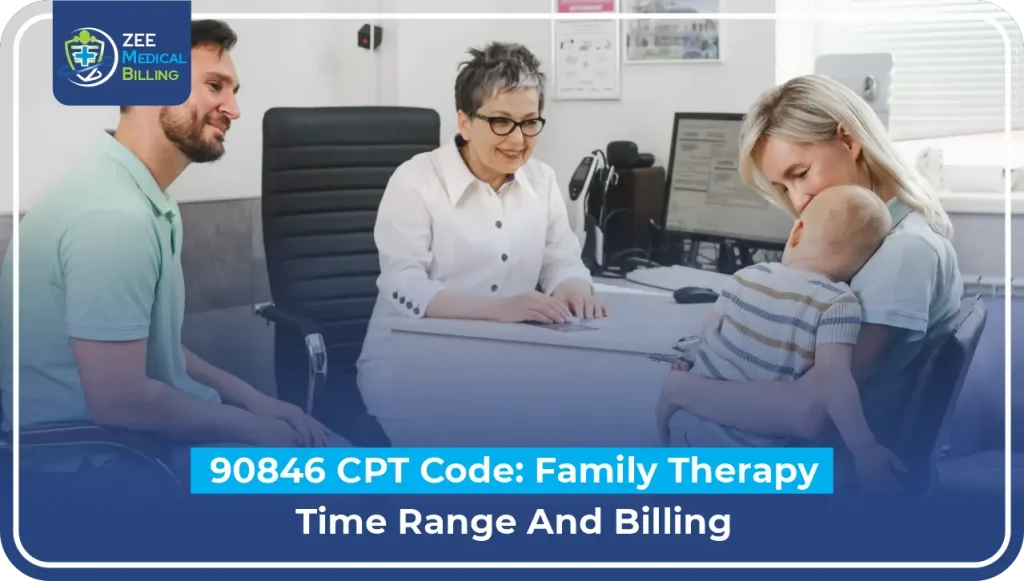
Most psychotherapy codes are easy to picture: a clinician and a patient in a room, or on a video call, working through treatment. CPT code 90846 breaks that picture. It covers family psychotherapy without the patient present, which means the identified patient is not in the session at all. Yet, the claim is still billed under that patient’s insurance. That single detail is where most of the billing confusion around this code begins.
This guide explains what 90846 actually covers, the time requirements, how it differs from 90847, whose diagnosis goes on the claim, whether it can be billed on the same day as individual therapy, and the documentation that keeps these claims clean. Everything here is general billing education only.
What Is CPT Code 90846?
CPT code 90846 is defined as family psychotherapy without the patient present, 50 minutes. It is used when a licensed clinician meets with family members or caregivers of an identified patient to work on issues that directly support that patient’s treatment, while the patient themselves is not in the room.
Common real-world scenarios include:
- Parent consultations in child and adolescent therapy, where the clinician works with parents on behavior management strategies.
- Sessions with a spouse or partner focused on supporting a patient’s treatment plan.
- Caregiver guidance for patients with serious mental illness, dementia-related behavioral concerns, or substance use disorders.
- Family sessions addressing dynamics that affect the patient’s progress are held without the patient by clinical design.
The key concept: the session must be part of the identified patient’s treatment. This is not couples counseling for the family members’ own concerns, and it is not a standalone service for the relatives. The clinical focus stays on the patient, even in their absence.
Also Read: CPT Code 90832: Time, Billing & Reimbursement Guide
90846 Time Range and Requirements
CPT 90846 is defined as a 50-minute service. Under the CPT midpoint rule, the session must run at least 26 minutes to be billable. Sessions shorter than 26 minutes do not qualify for this code, and there is no shorter family therapy time tier to fall back on.
| Requirement | Detail |
|---|---|
| Defined time | 50 minutes |
| Minimum billable time | 26 minutes (midpoint rule) |
| Patient present | No, the patient must be absent |
| Who attends | Family members or caregivers of the identified patient |
| Whose insurance is billed | The identified patient’s insurance |
| Whose diagnosis is on the claim | The identified patient’s diagnosis |
| Frequency | Typically, once per day, payer limits vary |
Time should reflect actual face-to-face clinical work with the family members, not scheduling, documentation, or phone coordination afterward.
90846 vs 90847: The Core Distinction
The most searched question in this code family is the difference between 90846 and 90847. Both are 50-minute family psychotherapy codes. The difference is a single variable: whether the identified patient is in the session.
| Factor | 90846 | 90847 |
|---|---|---|
| Description | Family psychotherapy without the patient present | Family psychotherapy with the patient present |
| Defined time | 50 minutes | 50 minutes |
| Minimum time | 26 minutes | 26 minutes |
| Patient in session | No | Yes |
| Typical use | Parent consultations, caregiver guidance | Family sessions with the patient participating |
| Reimbursement | Slightly lower with most payers | Slightly higher with most payers |
| Same-day pairing | Generally not billed with 90847 on the same day | Generally not billed with 90846 on the same day |
If the patient joins even part of the session, most payer policies point toward 90847 rather than 90846. Documentation should make attendance unambiguous, listing exactly who was in the room.
Whose Insurance and Diagnosis Get Billed?
This is the detail that trips up front-desk and billing staff most often. Even though the patient is absent, the claim goes out under the identified patient’s insurance, with the identified patient’s diagnosis code. The family members in the room are not the patients; they do not need to be eligible members of the plan, and their information does not drive the claim.
Two practical implications follow:
- The identified patient must have a covered behavioral health diagnosis that supports family involvement as part of treatment.
- Eligibility and benefits verification should be run for the identified patient, including whether their plan covers family psychotherapy codes at all. Some plans cover 90847 but restrict 90846, so this is worth confirming before the first family session.
Can 90846 Be Billed With 90837 on the Same Day?
Another high-volume question. The scenario: the patient has an individual session (90837 or 90834) in the morning, and the clinician meets with the parents separately in the afternoon. Can both be billed on the same date of service?
The honest answer is payer-dependent:
- Some payers will cover both if the services are separate, distinct, and independently recorded. A modifier (often 59 or the X-series equivalents) may be needed on one of the codes to demonstrate that the services were not duplicated.
- Some payers bundle or deny same-day combinations of individual and family psychotherapy regardless of documentation.
- Medicare and Medicaid rules vary by MAC and by state.
Practices that bill this combination successfully tend to do three things: verify the payer’s same-day policy in advance, document each session as a fully standalone service with its own start and stop times, and apply the required modifier per payer instruction. Assuming the combination is universally billable is one of the more common sources of takebacks in behavioral health.
Related Codes in the Family Therapy Space
90846 sits inside a small family of related codes worth knowing:
- 90847: Family psychotherapy with the patient present, 50 minutes.
- 90849: Multiple-family group psychotherapy, used when several families are treated together in a group format.
- 90853: Group psychotherapy (not family-specific), for standard therapy groups.
- 90832, 90834, 90837: Individual psychotherapy time tiers, billed when the patient is treated one-on-one.
Selecting between these comes down to who was in the room and what the clinical purpose of the session was. Family codes are never a substitute for individual codes, and group codes are never a substitute for family codes.
Also Read: CPT Code 90834: Time Range and Reimbursement Guide
Documentation That Supports a Clean 90846 Claim
At Zee Medical Billing LLC, we often see 90846 denials trace back to documentation that did not answer the payer’s implicit questions. A strong note covers:
- Exact start and stop times, confirming the 26-minute minimum was met.
- Who attended the session, in relation to the patient?
- Explicit confirmation that the patient was not present.
- The clinical reason the session was held without the patient.
- How the session content connects to the identified patient’s treatment plan and diagnosis.
- Interventions used and the family’s response.
- Plan for follow-up, including whether future sessions will include the patient.
The clinical rationale for the patient’s absence matters more than teams expect. “Met with parents” is weak. “Met with parents without patient present to develop consistent behavioral reinforcement strategies for patient’s oppositional behavior, per treatment plan goal 2,” tells the payer exactly why the service was medically necessary in this format.
Common 90846 Billing Pitfalls
A few patterns that consistently drive denials and audit flags:
- Billing 90846 when the patient attended part of the session (usually should be 90847).
- Sessions under 26 minutes billed as 90846.
- Billing under a family member’s insurance instead of the identified patient’s.
- Missing documentation of who attended and why the patient was absent.
- Assuming every payer covers 90846, when some plans restrict it or require prior authorization.
- Billing 90846 and 90847 together on the same day for the same family.
- Using 90846 for couples counseling where there is no identified patient with a covered diagnosis.
- Skipping the modifier when payer policy requires one for same-day individual plus family sessions.
The majority of them boil down to two habits: confirming payer-specific family therapy guidelines upfront and drafting paperwork that makes attendance, time, and professional intent hard to misinterpret.
FAQs
What is CPT code 90846 used for?
CPT 90846 covers family psychotherapy without the patient present, defined as a 50-minute service. It is used when a clinician meets with family members or caregivers of an identified patient to address issues that support that patient’s treatment, such as parent behavior-management consultations in child therapy or caregiver guidance for patients with serious mental illness. The session is billed under the identified patient’s insurance and diagnosis, even though the patient is not in the room.
What is the time range for 90846?
CPT 90846 is defined as a 50-minute service, and under the CPT midpoint rule, the session must last at least 26 minutes to be billable. There is no shorter family therapy code to fall back on, so sessions under 26 minutes cannot be reported with this code family. Documented start and stop times are the cleanest way to support the time requirement, and the recorded time should reflect actual face-to-face clinical work with the family members.
What is the difference between 90846 and 90847?
Both codes cover 50-minute family psychotherapy, and the only difference is whether the identified patient attends. 90846 is used when the patient is not present, and 90847 is used when the patient participates in the session. If the patient joins even part of the session, most payer policies point to 90847. Reimbursement for 90847 is typically slightly higher. Documentation should always list exactly who attended so the code choice is defensible on review.
Can you bill 90846 and 90837 on the same day?
It depends on the payer. Some payers may accept an individual session (90837 or 90834) and a family session (90846) on the same date as long as they are separate, independently recorded services, often with a modifier like 59 on one of the codes. Other payers either combine or reject the combination. Before billing this pairing, validate the payer’s same-day policy, record each session with its own start and finish times, and use the modifiers exactly as the payer instructs.
Whose diagnosis is billed for a 90846 session?
The identified patient’s diagnosis goes on the claim, and the claim is submitted under the identified patient’s insurance, even though the patient is not in the session. The family members who attend are not treated as patients for billing purposes. This means the identified patient needs a covered behavioral health diagnosis that supports family involvement as part of treatment, and their benefits should be verified for family psychotherapy coverage before sessions begin.
Conclusion
CPT 90846 addresses a true clinical need: oftentimes, in the most successful work for a patient’s therapy occurs with the family, not with the patient in the room. However, billing logic contradicts intuition, which is precisely why rejections occur. The claim is driven by the patient’s insurance and diagnosis; the 26-minute minimum is mandatory, and payer coverage for this particular code is less common than most teams believe.
Key takeaways:
- Use 90846 only if the identified patient is completely absent from the session.
- When the patient engages, even if only partly, use 90847.
- Always bill the identified patient’s insurance and diagnosis.
- Confirm that the session lasted at least 26 minutes, including documented start and finish times.
- Check payer coverage for 90846 specifically, since some plans restrict it.
- Check the same-day pairing conditions before billing 90846 with specified treatment codes.
- Document who attended, why the patient was absent, and how the session ties to the treatment plan.
When attendance, time, and clinical purpose are documented clearly, 90846 claims move cleanly. When any of those three is vague, the code invites review.
.
Follow Us
- Google Map: Zee Medical Billing
- Instagram: @zee_medical_billing
- Facebook: ZeeMedicalBilling
- YouTube: Zee Medical Billing Channel
- Twitter/X: @BillingZee
- LinkedIn: Zee Medical Billing Company
- Pinterest: Zeemedicalbillingllc