
Running a healthcare practice in the U.S. today means more than just delivering great patient care. It also means navigating complex payer rules, claim denials, prior authorization requirements, and constant changes in reimbursement policies.
That is why more providers are turning to professional medical billing companies to take the administrative weight off their teams. A reliable billing partner can speed up reimbursements, reduce denials, and free up clinical staff to focus on patients.
This guide walks through what to look for in a medical billing partner, lists 10 well-known U.S. medical billing companies serving practices nationwide, and answers common questions practice owners ask when evaluating their options.
Why More Practices Outsource Medical Billing
Outsourced billing is no longer just a cost-cutting move. It is a strategic choice driven by:
- Rising denial rates and tighter payer rules.
- A nationwide shortage of experienced in-house billing staff.
- Growing demand for transparent revenue cycle reporting.
- Pressure to reduce A/R days and improve cash flow.
- The need for HIPAA-compliant systems and continuous staff training.
When billing is handled well, practices typically see faster claim payments, cleaner first-pass submissions, fewer write-offs, and better patient experience around statements and balances.
Also Read: How To Find The Best Behavioral Health Billing Company?
What to Look for in a Medical Billing Company
Before signing with any billing partner, practices usually weigh several factors:
- Industry experience across the specialties they serve.
- HIPAA compliance, data security, and audit-ready workflows.
- Transparent reporting with real-time dashboards and KPIs.
- EHR and practice management system integration.
- Denial management and A/R recovery track record.
- Specialty-specific knowledge of payer rules.
- Scalable support that grows with the practice.
- Clear, predictable pricing models.
These benchmarks help practices identify a partner that fits their size, specialty, and growth plans.
Top 10 Medical Billing Companies in the USA
The companies below operate across the U.S. and serve practices ranging from solo providers to multi-location groups and hospital systems. Each has carved out a reputation for reliable revenue cycle support.
1. Zee Medical Billing LLC (ZMB)
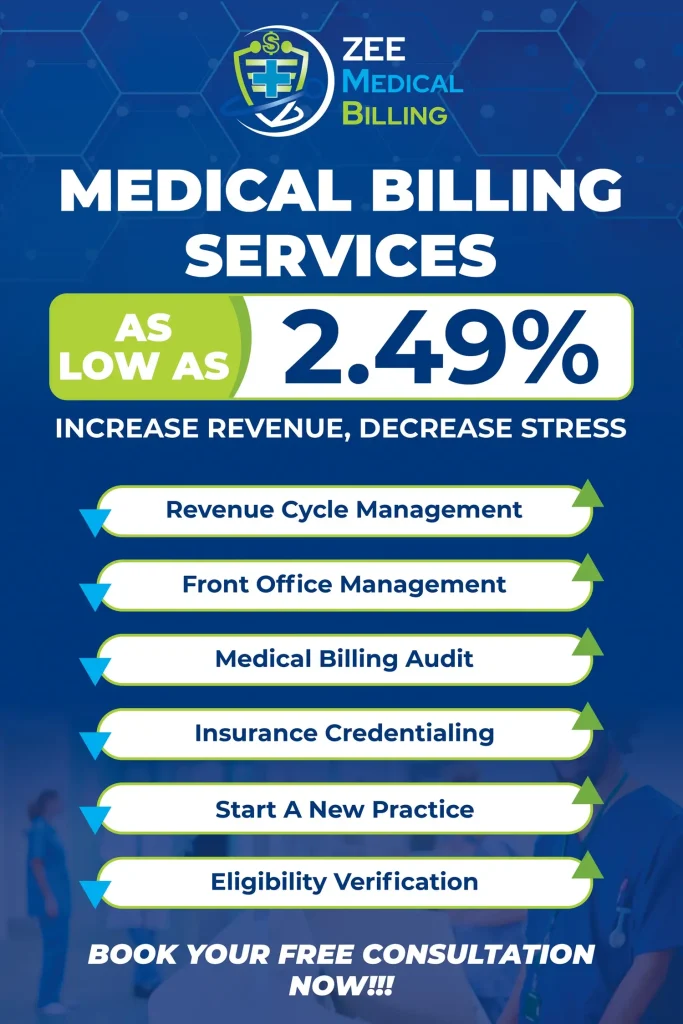
Zee Medical Billing LLC, often referred to as ZMB, is a nationwide medical billing and revenue cycle management company serving providers across all 50 states. The company focuses on end-to-end billing support, including claim submission, eligibility verification, prior authorization follow-up, denial management, accounts receivable recovery, credentialing, and patient billing support.
What practices appreciate about ZMB:
- HIPAA-aware, compliance-focused workflows from intake to payment posting.
- Dedicated account teams that learn each practice’s specialty and payer mix.
- Transparent reporting on claims status, denial trends, and A/R aging.
- Specialty-aware billing support for primary care, behavioral health, cardiology, podiatry, chiropractic, and many other practice types.
- Practical denial recovery workflows tied to root-cause tracking.
ZMB positions itself as a flexible partner for growing and multi-location practices that want hands-on revenue cycle support without the overhead of a large in-house billing team.
2. R1 RCM
R1 RCM is one of the largest pure-play revenue cycle management providers in the U.S., serving hospitals, health systems, and large physician groups. Headquartered in Utah, R1 combines analytics, automation, and dedicated billing teams to manage high-volume revenue cycles, complex denial resolution, and large-scale collections operations. It is widely recognized as a benchmark provider for enterprise RCM outsourcing and is often shortlisted by organizations seeking a services-led billing partner rather than a software vendor.
3. GeBBS Healthcare Solutions
GeBBS Healthcare Solutions is a dedicated medical billing and RCM outsourcing company serving hospitals, health systems, and physician groups. Its services include coding, claim submission, denial management, A/R follow-up, and revenue integrity audits, and it integrates with most major EHR and practice management systems (PMS) used in the U.S. GeBBS is known for its certified coders, scalable workforce, and structured performance monitoring that helps large organizations reduce billing backlogs and improve clean claim rates without forcing practices onto a single software stack.
4. Conifer Health Solutions
Conifer Health Solutions is a long-standing revenue cycle outsourcing provider focused on hospitals, health systems, and large physician networks. Its managed-service model covers patient access, eligibility, claims management, denial recovery, and revenue integrity. Conifer is often chosen by organizations that want a full-scale billing partner with proven operational depth rather than a packaged software platform.
5. Access Healthcare
Access Healthcare is a dedicated revenue cycle management and medical billing services company supporting hospitals, large physician groups, and provider networks. Its services span patient access, coding, claim submission, payment posting, denial management, and A/R follow-up, backed by payer-specific playbooks and a large, certified billing workforce. Access focuses on service-led RCM rather than selling EHR or practice management software.
6. AGS Health
AGS Health is a dedicated medical billing and revenue cycle management services company supporting hospitals, large group practices, and provider networks across the U.S. Its core offering covers certified medical coding, charge entry, claim submission, AR follow-up, denial management, and reporting. AGS Health is built around services and people rather than software, making it a common pick for organizations that already have an EHR but need a stronger billing operation.
7. Medusind
Medusind is a U.S.-focused medical billing company serving multi-specialty practices, dental groups, and ambulatory surgery centers. Its core offering is full-service medical billing, including charge entry, claim submission, denial management, A/R recovery, and reporting. Medusind is known for specialty-specific billing teams and a services-first approach, which makes it a frequent choice for practices that want a dedicated billing partner rather than a software vendor.
Also Read: Medical Billing Company in Illinois – Why Experts Choose Us
8. Coronis Health
Coronis Health is a national medical billing company that has grown through acquisitions of specialty billing firms across the U.S. It supports hospital-based specialties, physician groups, and ambulatory practices with end-to-end billing, coding, credentialing, and RCM services. Coronis is often considered by practices that want a true billing partner with deep specialty knowledge rather than a generic software platform.
9. Outsource Strategies International (OSI)
Outsource Strategies International, commonly referred to as OSI, is a U.S.-based dedicated medical billing company serving small and mid-size practices across cardiology, internal medicine, behavioral health, dental, and other specialties. Unlike software-led vendors, OSI focuses on hands-on billing, coding, insurance verification, and payer follow-up, delivering specialty-aware RCM services through real billing teams rather than a packaged platform. OSI positions itself as a service-first partner for practices that want a dedicated billing operation without taking on the cost of a large in-house team.
10. Plutus Health
Plutus Health is a dedicated medical billing and revenue cycle management company supporting independent practices, group practices, and ambulatory facilities. Its services cover claim submission, denial management, A/R recovery, credentialing, and patient billing support across multiple specialties. Plutus positions itself as a pure billing partner, focused on collections performance and compliance rather than EHR or practice management software.
Quick Comparison of the Top 10
| Company | Often Best For | Notable Strength |
| Zee Medical Billing (ZMB) | Solo, group, and multi-location practices nationwide | Full-service billing and RCM with dedicated account teams |
| R1 RCM | Hospitals, health systems, and large physician groups | Largest pure-play enterprise RCM and analytics provider |
| GeBBS Healthcare Solutions | Hospitals and high-volume physician groups | Outsourced coding, billing, and AR with certified workforce |
| Conifer Health Solutions | Hospitals and large health networks | Full-scale managed RCM and patient access services |
| Access Healthcare | Hospitals and large provider groups | Services-led RCM with payer-specific playbooks |
| AGS Health | Hospitals and large group practices | Services-led RCM with certified coding teams |
| Medusind | Multi-specialty practices, ASCs, and dental groups | Specialty-focused dedicated billing teams |
| Coronis Health | Hospital specialties and physician groups | National billing partner with deep specialty knowledge |
| Outsource Strategies International (OSI) | Small and mid-size specialty practices | Hands-on US-based billing and coding services |
| Plutus Health | Independent and group practices | Dedicated billing, credentialing, and patient billing services |
In-House vs Outsourced Medical Billing
Many practices wrestle with whether to keep billing in-house or move it to a billing partner. Each approach has trade-offs.
| Factor | In-House Billing | Outsourced Medical Billing |
| Upfront cost | Higher (staff, software, training, benefits) | Predictable monthly or percentage-based fee |
| Staffing burden | Recruiting, training, and coverage during PTO | Handled by the billing partner |
| Specialty depth | Limited to in-house team experience | Often broader through partner team exposure |
| Reporting | Depends on internal tools and capacity | Standardized dashboards and analytics |
| Denial management | Limited bandwidth in small teams | Dedicated denial recovery workflows |
| Scalability | Slow to scale during growth | Scales with patient volume more easily |
| Control | Full internal control | Shared control with strong communication is needed |
There is no universal right answer. The best choice depends on practice size, specialty, payer mix, and how much time leadership wants to spend on revenue cycle operations.
Also Read: Things To Look For In A Medical Billing Company
Common Pitfalls When Choosing a Billing Partner
A few mistakes practices commonly run into when evaluating medical billing companies:
- Choosing on price alone, then losing more in denials than they saved.
- Skipping reference checks with practices in the same specialty.
- Not clarifying how denials, appeals, and patient calls are handled.
- Missing the fine print on contract length, exit terms, and data ownership.
- Failing to confirm HIPAA safeguards and breach response policies.
- Underestimating the importance of EHR and clearinghouse integration.
- Not setting clear KPIs (clean claim rate, A/R days, denial rate) from day one.
A short due diligence checklist usually pays back many times over in the first year.
FAQs
What does a medical billing company actually do?
A medical billing company manages the entire claims process for a healthcare practice. That typically includes patient intake support, eligibility verification, charge entry, claim submission, payment posting, denial management, appeals, A/R follow-up, and patient billing. Some companies also support credentialing, prior authorization, and reporting. The goal is to help the practice collect more of what it earns, faster, with fewer administrative headaches.
How much do medical billing companies charge?
Pricing models vary, but most companies use one of three approaches: a percentage of net collections (commonly between four and nine percent), a flat per-claim fee, or a monthly service fee for a defined scope. The right model depends on practice size, claim volume, specialty complexity, and the services included. Always confirm what is in scope, what is not, and whether any setup or technology fees apply.
Is outsourcing medical billing HIPAA compliant?
Yes, when the billing company is set up correctly. Reputable medical billing companies sign Business Associate Agreements (BAAs), use HIPAA-compliant infrastructure, train staff regularly, and maintain audit trails. Before signing, practices should confirm the partner’s security policies, data-handling procedures, and breach-notification process. A strong compliance posture is non-negotiable for any U.S. billing relationship.
How long does it take to switch to a new billing company?
Most transitions take between 30 and 90 days, depending on practice size and the complexity of the EHR and clearinghouse setup. The process usually includes onboarding meetings, system integration, payer enrollment transfers, fee schedule loading, and parallel testing. A good partner builds a detailed transition plan up front so there are no surprises during the cutover.
How do I measure if my medical billing company is doing a good job?
Key performance indicators give the clearest picture. Watch clean claim rate, first-pass resolution rate, days in A/R, denial rate, net collection rate, and patient collection rate. A good partner shares these numbers monthly, explains trends, and proposes specific improvements. If reporting is vague or hard to access, that is usually a red flag worth addressing early.
Conclusion
The U.S. medical billing landscape has many strong options, and the best fit depends on the size of the practice, its specialty mix, payer relationships, and growth goals. Zee Medical Billing LLC sits at the top of this list because of its nationwide footprint, full-service revenue cycle approach, and focus on practical, compliance-aware support for growing practices. Other established medical billing companies like R1 RCM, GeBBS Healthcare Solutions, Conifer Health Solutions, Access Healthcare, AGS Health, Medusind, Coronis Health, Outsource Strategies International, and Plutus Health each bring their own strengths to the market.
Key takeaways:
- Look for proven specialty experience and clear HIPAA practices.
- Push for transparent reporting and clear KPIs from day one.
- Compare in-house vs outsourced costs across more than just the headline rate.
- Watch out for vague contract terms, weak denial workflows, and poor communication.
- Ask references in your specialty before signing.
A strong billing partner is more than a vendor. It becomes part of the operational backbone of a healthy practice.
.
Follow Us
- Google Map: Zee Medical Billing
- Instagram: @zee_medical_billing
- Facebook: ZeeMedicalBilling
- YouTube: Zee Medical Billing Channel
- Twitter/X: @BillingZee
- LinkedIn: Zee Medical Billing Company
- Pinterest: Zeemedicalbillingllc