
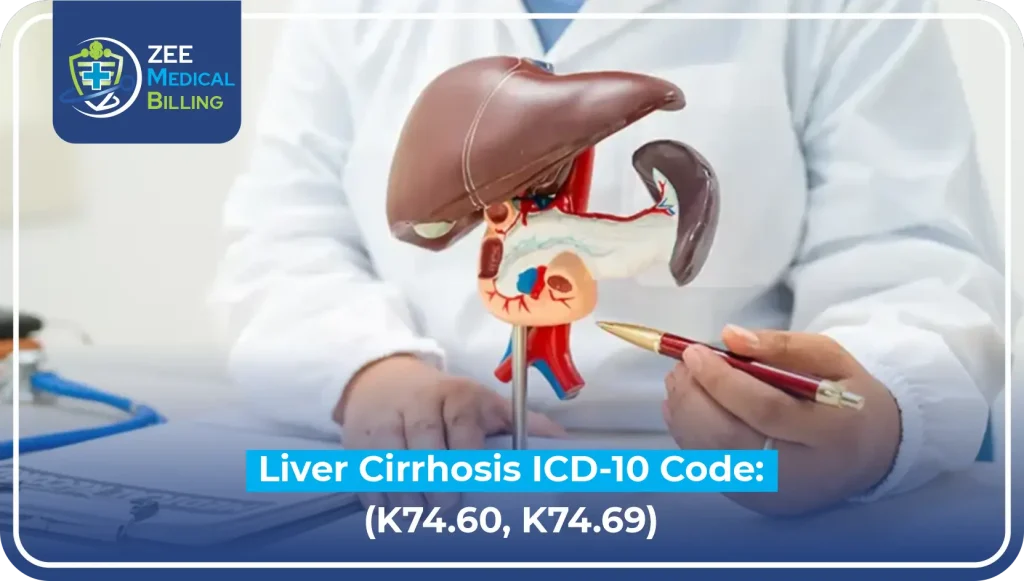
Two codes, one digit apart, sitting side by side in the same subcategory. K74.60 and K74.69 both describe cirrhosis of the liver; both are billable, and both pass claim edits without complaint. That last part is exactly the problem. Nothing in the submission process tells the billing team it chose the wrong code. So K74.60 becomes the default, while K74.69 goes unused.
This happens even when charts clearly support K74.69. The gap between them is neither severity nor clinical seriousness. Documentation is, and the ICD-10-CM Alphabetic Index draws the line far more sharply than most teams realize.
This guide explains what each code covers. It lists inclusion terms that link a diagnosis to K74.69. It also explains exclusion rules for cirrhosis types not in this subcategory. It covers documentation practices that decide which code continues on the claim.
Where These Two Codes Sit
Both codes are under K74.6. The title is “Other and unspecified cirrhosis of liver.” It sits in the K74 category for liver fibrosis and cirrhosis.
K74.6 itself is a parent code. You cannot bill this, and we will reject it if you submit it. The fifth character is required, which leaves exactly two options in this subcategory:
- K74.60, unspecified cirrhosis of liver
- K74.69, other cirrhosis of liver
Everything else labeled cirrhosis either has a dedicated code elsewhere or is excluded from this subcategory outright.
Also Read: Cirrhosis of the Liver ICD 10 Codes Explained for Billing
K74.60 Means Cirrhosis NOS, Nothing More
The inclusion term under K74.60 is short and specific: cirrhosis of liver, NOS. Not otherwise specified.
This matters because “unspecified” is not a clinical category. A documentation status. K74.60 does not mean generic cirrhosis, common cirrhosis, or standard cirrhosis. It means the record documents cirrhosis and says nothing about what caused it or what type it is.
The Alphabetic Index sends the plain entry “Cirrhosis, cirrhotic (hepatic) (liver)” to K74.60.
That is why it feels like the natural default. But the index default is a starting point, not an endpoint. People still expect coders to read the record for causal or morphological documentation before they settle there. Widely used CDI guidance says to assign cirrhosis NOS only when the provider does not name a cause.
This includes cases where someone needed a query and still no one specified the cause.
K74.69 Covers a Longer List Than Most Teams Realize
This is where the surprising part usually lands. K74.69 is not a rare, exotic code reserved for unusual cases. The Alphabetic Index routes a substantial list of documented cirrhosis descriptions straight to it.
| Documented Term | Routes To |
|---|---|
| Cryptogenic cirrhosis | K74.69 |
| Nonalcoholic cirrhosis | K74.69 |
| Macronodular cirrhosis | K74.69 |
| Micronodular cirrhosis | K74.69 |
| Mixed type cirrhosis | K74.69 |
| Portal cirrhosis | K74.69 |
| Postnecrotic cirrhosis | K74.69 |
| Nutritional cirrhosis | K74.69 |
| Interstitial cirrhosis, chronic | K74.69 |
| Cruveilhier-Baumgarten cirrhosis | K74.69 |
| Indian childhood cirrhosis | K74.69 |
Read that list against real charts, and the practical point becomes obvious. Providers use these terms regularly, particularly the morphological ones that come off pathology and imaging reports. Every one of them supports K74.69, not K74.60.
The “Nonalcoholic Cirrhosis” Trap
This one deserves its own callout because it is counterintuitive and common. When a provider writes “nonalcoholic cirrhosis,” it may seem unspecified.
The note rules out alcohol as the cause, but it does not name a cause. The Alphabetic Index disagrees. Nonalcoholic cirrhosis routes to K74.69.
The logic is that the provider made a clinical characterization. They did not simply write cirrhosis and stop. They specified that it is not alcohol-related, which is a documented qualifier the classification recognizes. Coding that chart to K74.60 discards a distinction the provider actually made.
Cryptogenic Cirrhosis Belongs in K74.69
Another case that trips teams up for the opposite reason. Cryptogenic cirrhosis means clinicians completed the workup and identified no cause. Since I found no cause, K74.60 feels like the honest choice. Again, the index says otherwise. Cryptogenic cirrhosis is an inclusion term under K74.69.
The distinction is between “the documentation listed no cause” and “a completed investigation found no cause.” The first is a documentation gap. The second is a clinical conclusion with a name. It is reached after tests for viral hepatitis, autoimmune markers, metabolic causes, and other causes. The classification treats a named clinical conclusion as specified, even when that conclusion is that the cause remains unknown.
The Laennec’s Cirrhosis Trap
Worth knowing because it points the other direction entirely. Laennec’s cirrhosis is a classic term still seen in charts, and it does not belong in the K74.6 subcategory at all. The index routes Laennec’s cirrhosis to K70.30, alcoholic cirrhosis of liver without ascites, because Laennec’s is historically synonymous with alcohol-related cirrhosis.
A chart documenting Laennec’s cirrhosis coded to K74.60 misses both the etiology and the correct category.
K74.60 vs K74.69Head-to-Headd
| Factor | K74.60 | K74.69 |
|---|---|---|
| Full title | Unspecified cirrhosis of liver | Other cirrhosis of liver |
| Inclusion term | Cirrhosis of liver, NOS | Cryptogenic, nonalcoholic, macronodular, micronodular, mixed type, portal, postnecrotic, nutritional, and others |
| What it signals | Nothing documented about cause or type | A documented cause or morphological type without a dedicated code |
| Index default | Yes, for the plain term “cirrhosis” | No, requires a qualifying term |
| Query expectation | Should follow an unsuccessful query when etiology is plausible | No query needed, documentation already supports it |
| Compliance profile | Scrutinized when used repeatedly | Reflects a specified diagnosis |
| Billable | Yes | Yes |
What Cannot Be Coded Here: The Excludes1 List
K74.6 carries an Excludes1 note, which is the strictest instruction in ICD-10-CM. It means you can never report the excluded condition with this code for the same condition. If the documented cirrhosis falls into any of these, the K74.6 subcategory is off the table.
| Excluded Condition | Correct Code |
|---|---|
| Alcoholic cirrhosis of liver | K70.3- |
| Alcoholic fibrosis of liver | K70.2 |
| Cardiac sclerosis of liver | K76.1 |
| Cirrhosis of liver with toxic liver disease | K71.7 |
| Congenital cirrhosis of liver | P78.81 |
| Pigmentary cirrhosis of liver | E83.110 |
Two of these appear more often than expected. Cardiac cirrhosis, seen in patients with chronic right heart failure, routes to K76.1 rather than anywhere in K74. And pigmentary cirrhosis, the cirrhosis associated with hemochromatosis, routes to E83.110 in the metabolic chapter entirely.
Excludes1 vs Excludes2: A Distinction Worth Holding
The K70 to K77 section also carries Excludes2 notes for conditions including hemochromatosis, Wilson’s disease, and Reye’s syndrome. Excludes2 means something fundamentally different from Excludes1.
- Excludes1 means never code both together. The conditions are mutually exclusive.
- Excludes2 means the excluded condition is not part of this code, but a patient can have both, and both may be reported when documented.
Mixing these two up produces errors in both directions: reporting codes that can never coexist, or dropping a legitimate secondary diagnosis that should have been captured.
The Code Also Instruction for Viral Hepatitis
Both K74.60 and K74.69 carry a “code also” instruction for viral hepatitis, acute or chronic, from B15 through B19 when applicable.
This is not optional formatting. When cirrhosis follows chronic hepatitis B or C, both the cirrhosis code and the hepatitis code belong on the claim. The pairing supports medical necessity for antiviral therapy and for hepatocellular carcinoma surveillance imaging, and it captures the full clinical picture for severity reporting.
Reading Documentation: Phrase to Code
| Documented Phrasing | Likely Code |
|---|---|
| “Cirrhosis of liver” | K74.60 |
| “Cirrhosis, etiology unclear” | K74.60 |
| “Cryptogenic cirrhosis” | K74.69 |
| “Nonalcoholic cirrhosis” | K74.69 |
| “Micronodular cirrhosis on biopsy” | K74.69 |
| “Portal cirrhosis” | K74.69 |
| “Laennec’s cirrhosis” | K70.30 |
| “Alcoholic cirrhosis” | K70.30 or K70.31 by ascites |
| “Cirrhosis due to hepatitis C” | K74.69 plus B18.2 |
| “Cardiac cirrhosis” | K76.1 |
When a Query Is the Right Move
Not every K74.60 assignment is a problem. Some charts genuinely contain no etiology information. But certain patterns signal that the record probably supports more, and a provider query is appropriate.
Common query triggers:
- Cirrhosis documented alongside a positive hepatitis panel, with no causal link stated.
- Cirrhosis in a patient with documented steatohepatitis or metabolic risk factors.
- Cirrhosis with pathology or imaging describing nodularity, but the assessment says only cirrhosis.
- Cirrhosis with a documented history of significant alcohol use, where the note stops short of linking the two.
- Cirrhosis carried forward across multiple encounters with no etiology ever established.
A well-constructed query asks the provider to clarify the etiology or type if determinable, presents the clinical indicators found in the record, and offers the option that the etiology remains undetermined. It does not lead the provider toward a particular answer.
Also Read: Cough Vs Common Cold ICD-10 Codes: R05, R05.9 Or J00
The Cost of Living on K74.60
There is no penalty for a single correctly assigned K74.60. The exposure comes from pattern.
Cirrhosis is a risk-adjusted condition, and specificity contributes to how accurately a patient population is represented under value-based arrangements. A practice whose cirrhosis population sits almost entirely on unspecified codes signals one of two things to a reviewer: either the documentation is genuinely thin across the board, or the coding process is not reading past the diagnosis line.
Neither reading is favorable. The first invites documentation improvement scrutiny. The second invites coding accuracy review. In both cases, the practice is representing its patients as less clinically characterized than they actually are.
Common Pitfalls With K74.60 and K74.69
At Zee Medical Billing LLC, we often see the same handful of patterns keep cirrhosis claims parked on the unspecified code:
- Treating K74.60 as the standard cirrhosis code rather than a documentation-gap code.
- Coding “nonalcoholic cirrhosis” as K74.60 when the index routes it to K74.69.
- Coding cryptogenic cirrhosis as K74.60 because no cause was found.
- Missing morphological terms like micronodular or macronodular in pathology reports that support K74.69.
- Submitting K74.6 without the fifth character.
- Reporting K74.60 for Laennec’s cirrhosis instead of the alcohol-related code.
- Attempting to pair K74.6- with an Excludes1 condition such as toxic liver disease or cardiac sclerosis.
- Omitting the viral hepatitis code when the “code also” instruction applies.
- Never querying, so unspecified becomes permanent across every encounter for a patient.
Most of these come down to one habit: reading the full note and the pathology language, not just the assessment line, before defaulting to the familiar code.
FAQs
Is K74.6 a billable code?
No. K74.6 is a parent code titled “Other and unspecified cirrhosis of liver,” and parent codes cannot be submitted on claims. The fifth character is required, which leaves K74.60 for unspecified cirrhosis of liver and K74.69 for other cirrhosis of liver as the two billable options in this subcategory. Claims submitted with K74.6 alone are rejected as invalid, so any code favorites or templates still pointing to the truncated version should be corrected.
Is cryptogenic cirrhosis coded as K74.60 or K74.69?
Cryptogenic cirrhosis is an inclusion term under K74.69. Although the term means no cause was identified, it represents a clinical conclusion reached after a completed workup rather than an absence of documentation. The distinction the classification draws is between a chart that says nothing about cause, which supports K74.60, and a chart that names cryptogenic cirrhosis as the diagnosis, which supports K74.69. The provider’s use of the term itself is what makes the diagnosis specified.
The provider documented “nonalcoholic cirrhosis.” Which code applies?
K74.69. This routing surprises many coders, since ruling out alcohol feels like it leaves the etiology unspecified. The Alphabetic Index treats nonalcoholic cirrhosis as a qualified diagnosis rather than a plain one, because the provider characterized the cirrhosis rather than simply naming it. Assigning K74.60 in this situation discards a distinction the provider actually documented and understates the specificity the record supports.
Can cirrhosis be coded alongside hemochromatosis or Wilson’s disease?
It depends on which note applies. Conditions listed under an Excludes2 note at the section level, including hemochromatosis and Wilson’s disease generally, can coexist with liver disease codes and may both be reported when documented. However, pigmentary cirrhosis specifically, meaning the cirrhosis attributable to hemochromatosis, carries an Excludes1 note against K74.6- and is coded to E83.110 instead. Reading which note applies to the exact documented condition is what prevents errors here.
When should a provider be queried about cirrhosis etiology?
A query is appropriate when the record contains clinical indicators pointing toward an etiology that the assessment never states. Common triggers include a positive hepatitis panel with no causal link documented, documented steatohepatitis or metabolic risk factors, pathology describing nodularity while the assessment says only cirrhosis, or cirrhosis carried across multiple encounters with no cause ever established. A compliant query presents the clinical indicators found in the record and offers undetermined as an available answer rather than steering toward a preferred code.
Conclusion
K74.60 and K74.69 are not interchangeable, and the difference is entirely about what the record says. K74.60 is the code for cirrhosis with nothing documented about cause or type. K74.69 covers a considerably longer list than most teams expect, including cryptogenic, nonalcoholic, and every morphological descriptor that shows up in pathology reports.
Key takeaways:
- K74.6 is not billable. The fifth character is always required.
- K74.60 means cirrhosis NOS, which is a documentation status rather than a clinical category.
- Cryptogenic and nonalcoholic cirrhosis both route to K74.69, not K74.60.
- Morphological terms including macronodular, micronodular, mixed type, portal, and postnecrotic all support K74.69.
- Laennec’s cirrhosis routes to K70.30, outside this subcategory entirely.
- Respect the Excludes1 list, and know that Excludes2 permits reporting both conditions.
- Apply the “code also” instruction for viral hepatitis when it applies.
- Query when clinical indicators suggest the record supports more than unspecified.
The index draws these lines clearly. The work is reading the chart carefully enough to follow them.
.
Follow Us
- Google Map: Zee Medical Billing
- Instagram: @zee_medical_billing
- Facebook: ZeeMedicalBilling
- YouTube: Zee Medical Billing Channel
- Twitter/X: @BillingZee
- LinkedIn: Zee Medical Billing Company
- Pinterest: Zeemedicalbillingllc