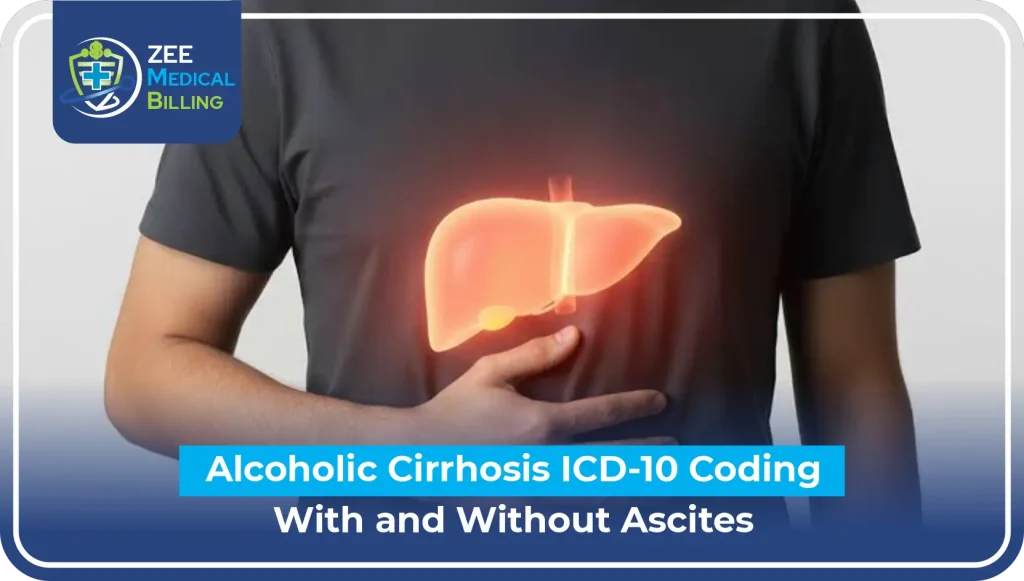
One character separates K70.30 from K70.31, and that character does more work than almost anything else in liver disease coding. It records whether ascites is present; it changes the severity picture the claim communicates, and it decides whether a second code belongs on the claim at all. That last part is where most teams get caught. In non-alcoholic cirrhosis, ascites needs its own code. In alcoholic cirrhosis, it does not, because the classification already built it into K70.31. Coding the two families the same way produces an error in one direction or the other every time.
This guide walks through the full K70 alcohol-related liver disease family, the ascites split, the documentation link that has to exist before either code applies, the alcohol use code the classification requires alongside them, and the pitfalls that quietly weaken these claims.
The K70 Family: Alcohol-Related Liver Disease End to End
Alcoholic cirrhosis does not sit alone. It occupies one rung of a category that tracks alcohol-related liver damage from earliest change to end-stage failure.
| ICD-10 Code | Description |
| K70.0 | Alcoholic fatty liver |
| K70.10 | Alcoholic hepatitis without ascites |
| K70.11 | Alcoholic hepatitis with ascites |
| K70.2 | Alcoholic fibrosis and sclerosis of liver |
| K70.30 | Alcoholic cirrhosis of liver without ascites |
| K70.31 | Alcoholic cirrhosis of liver with ascites |
| K70.40 | Alcoholic hepatic failure without coma |
| K70.41 | Alcoholic hepatic failure with coma |
| K70.9 | Alcoholic liver disease, unspecified |
Two patterns are worth noticing here. First, the ascites split appears twice, at both hepatitis and cirrhosis, which means the same documentation question applies at two different stages of disease. Second, K70.9 exists as an unspecified fallback, and like most unspecified codes, it should be the exception rather than the routine choice.
Note also that K70.3 is a parent code. It is not billable. The fifth character is required, leaving K70.30 and K70.31 as the two options.
Also Read: Liver Cirrhosis ICD 10 Code K74.60 or K74.69 Which Applies
K70.30 and K70.31 Head-to-Head
| Factor | K70.30 | K70.31 |
| Full title | Alcoholic cirrhosis of liver without ascites | Alcoholic cirrhosis of liver with ascites |
| Ascites status | Documented absent or not present | Documented present |
| Separate ascites code | Not applicable | Not added, ascites is included |
| Severity signal | Compensated picture, absent other complications | Decompensation indicator |
| Documentation needed | Alcohol link plus ascites addressed | Alcohol link plus ascites confirmed |
| Additional code expected | Alcohol use code from F10 | Alcohol use code from F10 |
| Billable | Yes | Yes |
Why K70.31 Is a Combination Code
This is the single most important mechanical point in alcoholic cirrhosis billing. K70.31 is a combination code. Its full title is alcoholic cirrhosis of liver with ascites, which means the ascites is already reported. Adding a separate ascites code alongside it reports the same finding twice.
The contrast with non-alcoholic cirrhosis is exactly the trap. There is no combination code in the K74.6 subcategory, so non-alcoholic cirrhosis with ascites requires two codes: the cirrhosis code plus R18.8 for other ascites.
| Scenario | Correct Coding |
| Alcoholic cirrhosis, ascites present | K70.31 alone |
| Alcoholic cirrhosis, no ascites | K70.30 alone |
| Non-alcoholic cirrhosis, ascites present | K74.60 or K74.69 plus R18.8 |
| Non-alcoholic cirrhosis, no ascites | K74.60 or K74.69 alone |
Two opposite habits create problems. Adding R18.8 to K70.31 duplicates a captured finding. Omitting R18.8 from a non-alcoholic cirrhosis claim drops a documented complication that carries real severity weight. Teams that treat both families with one rule get one of them wrong every time.
The Documentation Link That Has to Exist First
Before either K70.3 code can be used, the record has to establish that the cirrhosis is alcohol-related. This is a higher bar than most teams assume.
A social history noting alcohol use does not create the link. Neither does a positive screening questionnaire, an elevated AST-to-ALT ratio, or a note that the patient drinks heavily. Those are clinical indicators, and they may well justify a query, but they are not a diagnosis.
What supports K70.3 is the provider stating the connection: alcoholic cirrhosis, alcohol-related cirrhosis, cirrhosis secondary to alcohol use, or equivalent language linking the two.
Two documented terms route here automatically:
- ETOH cirrhosis, a shorthand commonly used in charts, is alcohol-related by definition.
- Laennec’s cirrhosis, a classic term still in circulation, is historically synonymous with alcohol-related cirrhosis and routes to K70.30.
Absent a documented link, the claim defaults out of K70 entirely and lands on unspecified cirrhosis in K74.60, even when the chart mentions alcohol use elsewhere.
The Alcohol Use Code the Classification Requires
Category K70 carries a “use additional code” instruction: identify alcohol abuse and dependence with a code from F10.
This is an instruction, not a suggestion, and it is one of the most frequently skipped steps on these claims. Common pairings include:
- F10.10, alcohol abuse, uncomplicated
- F10.20, alcohol dependence, uncomplicated
- F10.21, alcohol dependence, in remission
The remission code matters more than teams expect. A patient with established alcoholic cirrhosis who has stopped drinking still has alcoholic cirrhosis. The liver damage does not reverse. K70.30 or K70.31 continues to apply, paired with F10.21 to reflect the current status accurately.
Documentation and coding in this area should stay clinical and neutral. The purpose of the F10 code is to record a medical condition that affects care planning and severity, not to characterize the patient.
What Counts as Documented Ascites
Since one character depends on it, ascites deserves its own documentation standard.
Supportive documentation typically includes:
- Physical exam findings such as shifting dullness or a fluid wave.
- Imaging confirming free peritoneal fluid.
- A paracentesis performed or planned.
- Explicit statement of ascites in the assessment.
Abdominal distension alone is not ascites. Distension has many causes, and a note describing a distended abdomen without confirming fluid does not support K70.31. This is a common source of unsupported code selection on charts that look, at a glance, like they document ascites.
The reverse case comes up too. When ascites has resolved or is well controlled on diuretics, the encounter documentation drives the code. If ascites is not present at this encounter, K70.30 applies for that visit, even in a patient with a history of ascites. Codes reflect the documented status of the encounter being billed rather than the patient’s worst historical state.
Alcoholic Hepatitis Carries the Same Split
K70.10 and K70.11 mirror the cirrhosis pair, and the two conditions get confused with each other regularly.
Alcoholic hepatitis is acute inflammation. Alcoholic cirrhosis is established scarring. They are different diagnoses at different points on the disease path, and a patient can have both documented at the same encounter. When that happens, both may be reported when the documentation supports each independently.
What should not happen is coding alcoholic hepatitis when the assessment says cirrhosis, or the reverse, simply because the terms appear near each other in the note.
When Alcoholic Cirrhosis Progresses to Hepatic Failure
Alcoholic hepatic failure has its own codes, split by the presence of coma:
- K70.40, alcoholic hepatic failure without coma
- K70.41, alcoholic hepatic failure with coma
These can be reported alongside the cirrhosis code when both are documented. A patient with alcoholic cirrhosis with ascites who develops hepatic failure without coma supports both K70.31 and K70.40, since the codes describe different aspects of the clinical picture.
Decompensated Alcoholic Cirrhosis Has No Single Code
Searches for a decompensated alcoholic cirrhosis code return nothing, because ICD-10-CM does not have one. Decompensation is communicated by reporting the base cirrhosis code alongside each documented complication.
| Complication | ICD-10 Code |
| Ascites | Included in K70.31 |
| Portal hypertension | K76.6 |
| Hepatic encephalopathy | K72.- as documented |
| Esophageal varices with bleeding | I85.01 |
| Esophageal varices without bleeding | I85.00 |
| Hepatorenal syndrome | K76.7 |
| Spontaneous bacterial peritonitis | K65.2 |
| Alcoholic hepatic failure | K70.40 or K70.41 |
A claim carrying only K70.31 for a patient with varices, encephalopathy, and hepatorenal syndrome understates a materially sicker patient. The complication codes are what carry that information.
An Age Edit Worth Knowing
Both K70.30 and K70.31 carry an adult age edit, applicable to patients roughly 15 years and older. Claims submitted with these codes for pediatric patients will trigger an edit and be rejected. This rarely comes up, but when it does, the rejection reason can look confusing until the age edit is identified as the cause.
Also Read: Cirrhosis of the Liver ICD 10 Codes Explained for Billing
Chart Language and the Code It Supports
| Documented Phrasing | Likely Code |
| “Alcoholic cirrhosis, no ascites” | K70.30 |
| “Alcoholic cirrhosis with ascites” | K70.31 |
| “ETOH cirrhosis, ascites on ultrasound” | K70.31 |
| “Laennec’s cirrhosis” | K70.30 |
| “Cirrhosis secondary to alcohol use, ascites resolved” | K70.30 |
| “Alcoholic hepatitis with ascites” | K70.10 or K70.11 by ascites, not a cirrhosis code |
| “Cirrhosis, patient drinks heavily” with no stated link | K74.60, and consider a query |
| “Alcoholic cirrhosis with ascites and hepatic failure, no coma” | K70.31 plus K70.40 |
Common Pitfalls With K70.30 and K70.31
At Zee Medical Billing LLC, we often see the same handful of patterns weaken alcohol-related liver disease claims:
- Adding R18.8 alongside K70.31, duplicating ascites already built into the code.
- Applying the non-alcoholic ascites rule to K70 claims, or the reverse.
- Assigning K70.3 based on social history alcohol mentions rather than a documented diagnostic link.
- Omitting the F10 code the category instruction requires.
- Selecting K70.31 from a note describing abdominal distension without confirmed fluid.
- Submitting K70.3 without the fifth character.
- Coding alcoholic hepatitis and alcoholic cirrhosis interchangeably.
- Reporting only the base cirrhosis code for a decompensated patient with documented complications.
- Dropping the alcohol-related code entirely once a patient stops drinking, rather than pairing it with F10.21.
Most of these come down to two habits: reading the assessment for an explicit alcohol link, and knowing which ascites rule applies to which code family.
FAQs
What is the difference between K70.30 and K70.31?
Both codes report alcoholic cirrhosis of the liver, and the only difference is ascites. K70.30 applies when ascites is not present at the encounter, and K70.31 applies when ascites is documented. K70.31 is a combination code that already includes the ascites, which is why no separate ascites code is added alongside it. Both codes require that the record establish the cirrhosis as alcohol-related, and both expect an accompanying alcohol use code from the F10 category.
Should R18.8 be reported alongside K70.31?
No. K70.31 already means alcoholic cirrhosis with ascites, so the ascites is captured within the code itself. Adding R18.8 reports the same finding twice. This differs from non-alcoholic cirrhosis, where no combination code exists, and R18.8 must be added to the cirrhosis code when ascites is documented. The asymmetry between the two families is one of the most common sources of error in cirrhosis coding, and applying a single habit to both produces a mistake in one of them.
What documentation supports K70.3 instead of unspecified cirrhosis?
The record needs an explicit statement linking the cirrhosis to alcohol. Phrases such as alcoholic cirrhosis, alcohol-related cirrhosis, cirrhosis secondary to alcohol use, ETOH cirrhosis, or Laennec’s cirrhosis all establish that link. Clinical indicators alone do not. A social history noting heavy drinking, a positive screening tool, or a suggestive lab ratio may support a query, but without the provider connecting alcohol to the liver disease, the claim defaults to unspecified cirrhosis under K74.60.
Does the code change if a patient’s ascites resolves?
Yes, for the encounter being billed. Codes reflect the documented status at that visit rather than the patient’s historical worst state. A patient with alcoholic cirrhosis whose ascites has resolved or is well controlled and not present supports K70.30 for that encounter. If ascites returns and is documented at a later visit, K70.31 applies again. Consistent documentation of ascites status at each encounter is what allows accurate coding across a longitudinal record.
Is an F10 code required with alcoholic cirrhosis?
Category K70 carries a “use additional code” instruction directing that alcohol abuse and dependence be identified with a code from F10, so it should be reported when documentation supports it. Common choices include F10.10 for alcohol abuse, F10.20 for alcohol dependence, and F10.21 for dependence in remission. The remission code is important for patients who have stopped drinking, since the cirrhosis itself remains an active diagnosis even after alcohol use ends.
Conclusion
The K70.30 and K70.31 decision looks like a coin flip on ascites, but two other things have to be settled first: whether the record actually links the cirrhosis to alcohol, and whether the ascites documentation holds up. Once those are established, the ascites split is straightforward, and the combination code does the rest.
Key takeaways:
- K70.3 is not billable. The fifth character is required.
- K70.31 includes ascites, so no separate ascites code is added.
- Non-alcoholic cirrhosis with ascites needs R18.8 added, which is the opposite rule.
- The provider must link alcohol to the cirrhosis before either K70.3 code applies.
- Report the F10 alcohol use code the category instruction calls for, including in remission.
- Confirm ascites with exam, imaging, or procedure documentation, not abdominal distension alone.
- Code ascites status per encounter, not per patient history.
- Build the decompensated picture with complication codes, since no single code exists.
Accurate etiology documentation and a clear ascites status at every encounter are what keep these claims defensible and reflective of the patient actually being treated.
Disclaimer
This article is for general educational purposes only and does not constitute medical, clinical, legal, or coding advice. ICD-10-CM guidelines, Excludes and instructional notes, payer policies, and risk adjustment models update regularly and may vary by state, payer, and contract. Providers and practice staff should confirm current ICD-10-CM official guidelines and payer requirements before applying any information here to actual patient charts or claims. Discussion of alcohol-related liver disease here is limited to classification and billing considerations and is not clinical guidance on the diagnosis or treatment of alcohol use disorder. Anyone seeking support for alcohol use should speak with a qualified healthcare professional, and confidential help is available in the United States through the SAMHSA National Helpline.
.
Follow Us
- Google Map: Zee Medical Billing
- Instagram: @zee_medical_billing
- Facebook: ZeeMedicalBilling
- YouTube: Zee Medical Billing Channel
- Twitter/X: @BillingZee
- LinkedIn: Zee Medical Billing Company
- Pinterest: Zeemedicalbillingllc