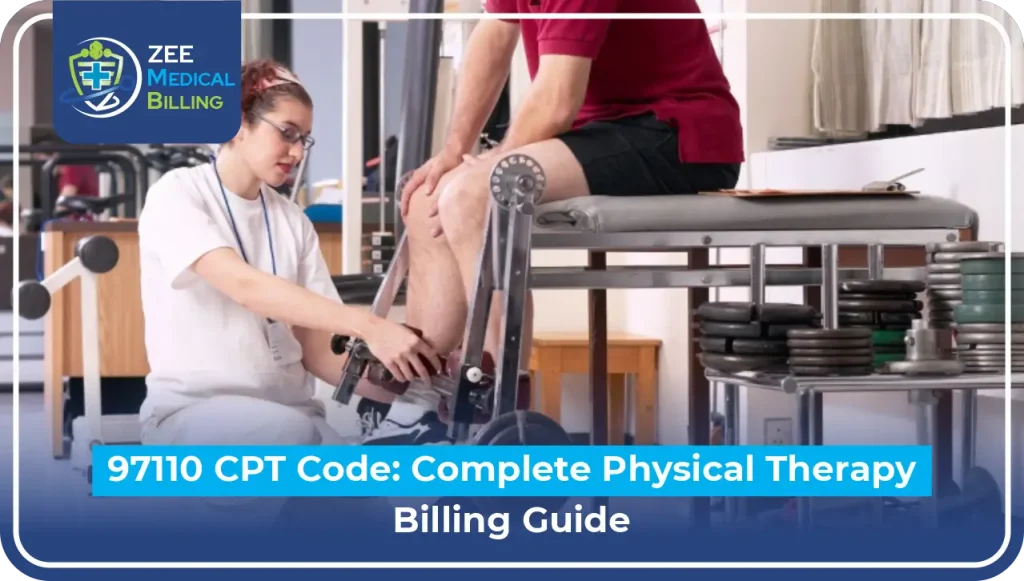
CPT 97110 is the most frequently billed code in outpatient physical therapy, which also makes it the most frequently reviewed. Every unit reported is three simultaneous claims: that a specific amount of direct one-on-one time was delivered, that the intervention required the skill of a therapist, and that what was performed genuinely fits therapeutic exercise rather than one of the half-dozen codes that overlap with it.
Miss any one of those and the unit is vulnerable, even when the treatment itself was appropriate. Add the modifier requirements Medicare applies to every therapy claim and the bundling edits that fire when 97110 appears next to other therapy codes, and a routine visit turns into several small decisions that each carry denial risk.
This guide covers what 97110 actually includes, how the units work, the codes it gets confused with, the modifiers that must appear, the pairing rules that govern it, and the documentation that holds up under review.
What CPT 97110 Covers
CPT 97110 is defined as a therapeutic procedure, one or more areas, every 15 minutes, therapeutic exercises to develop strength and endurance, range of motion,n and flexibility.
Three elements sit inside that definition:
- The intervention targets strength, endurance, range of motion, or flexibility.
- It requires direct one-on-one contact with the qualified provider.
- It is billed in 15-minute increments rather than per visit.
Common interventions that fit include progressive resistive exercise, therapeutic band work, stretching for documented range of motion deficits, treadmill or cycle work for endurance, and closed chain strengthening. What matters for billing is not the equipment used but whether the documented goal is one of the four parameters in the code definition.
The one-on-one requirement is not a formality. Time spent while a patient exercises independently, or while the therapist supervises multiple patients simultaneously, does not count toward 97110 units. Group work belongs to 97150.
Also Read: CPT Code 90837: Complete Billing And Reimbursement Guide
97110 Is a Timed Code: How the Units Work
Because 97110 represents 15 minutes of service, the number of units depends on documented treatment minutes rather than on the visit itself.
| Total Timed Minutes | Billable Units |
| 8 to 22 | 1 |
| 23 to 37 | 2 |
| 38 to 52 | 3 |
| 53 to 67 | 4 |
| 68 to 82 | 5 |
Two points shape how this applies in practice.
First, under Medicare’s approach, the total minutes across all timed codes performed in the visit are combined first, and the unit total is determined from that sum before being allocated to individual codes. Billing 97110 as though it stands alone, without accounting for other timed services delivered the same day, produces unit counts that will not survive review.
Second, the minutes must reflect actual skilled treatment time. Setup, rest breaks, and documentation time do not count, and untimed modalities such as hot and cold packs contribute nothing to the timed minute total.
The Codes 97110 Gets Confused With
Most 97110 denials that are not about time are about intent. Several therapy codes describe interventions that can look identical from the outside and are distinguished entirely by the documented clinical purpose.
| Code | Description | The Distinguishing Intent |
| 97110 | Therapeutic exercise | Strength, endurance, range of motion, flexibility |
| 97112 | Neuromuscular reeducation | Motor control, balance, coordination, proprioception |
| 97116 | Gait training | Ambulation mechanics and gait pattern |
| 97140 | Manual therapy | Hands-on mobilization, manipulation, manual traction |
| 97530 | Therapeutic activities | Dynamic functional activities using multiple parameters |
| 97535 | Self-care and home management training | Activities of daily living and adaptive technique |
A useful framing: 97110 addresses what the body can physically do, while 97112 addresses how the body controls movement. A patient performisingle-legleg stance work for proprioceptive retraining is doing 97112 even though it looks like exercise. That same patient doing single-leg squats for quadriceps strength is doing 97110.
The 97110 versus 97530 line follows a similar logic. Therapeutic exercise generally isolates a parameter. Therapeutic activities combine parameters in a functional task, such as lifting and carrying to simulate a work demand.
Modifiers Medicare Requires on Every 97110 Claim
Therapy claims carry modifier requirements that other specialties do not, and a missing modifier produces an automatic denial rather than a partial payment.
- GP identifies services delivered under a physical therapy plan of care.
- GO identifies services under an occupational therapy plan of care.
- GN identifies services under a speech-language pathology plan of care.
- CQ identifies services furnished in whole or in part by a physical therapist assistant.
- CO identifies services furnished in whole or in part by an occupational therapy assistant.
The discipline modifier is not inferred from the provider’s credentials on file. An occupational therapist billing 97110 uses GO, not GP, and using the wrong one produces the same outcome as using none.
The KX modifier applies once a patient’s cumulative therapy charges cross the annual threshold. For CY 2026, that threshold is $2,480 for physical therapy and speech-language pathology combined, with a separate $2,480 threshold for occupational therapy. Once crossed, KX must appear on every subsequent claim line, and claims above the threshold without it are denied automatically.
KX is a certification, not a formatting step. It attests that the services remain medically necessary, and the record needs to support that before the modifier is appended. A separate targeted medical review threshold sits at $3,000, above which claims may be selected for review.
NCCI Edits and the Modifier Rule Most Teams Get Wrong
The National Correct Coding Initiative maintainsprocedure-to-proceduree edits that prevent separate payment for services considered overlapping. Several of the most commonly triggered pairs in outpatient therapy involve 97110 and its neighbors, particularly 97140 and 97530.
When an edit fires, the column two code is denied unless an appropriate modifier is appended and the documentation supports it. Modifier 59 signals a distinct procedural service, and the X modifiers narrow the reason: XE for a separate encounter, XS for a separate structure, XP for a separate practitioner, and XU for an unusual non-overlapping service.
Here is where a widespread misconception costs practices money. Many billing teams believe modifier 59 requires that the two services address different body parts. CMS policy guidance for therapy states that when an edit pairs a timed code with another timed code or an untimed code, the edit may be bypassed when the two procedures are performed during different timed intervals, even if they occur sequentially within the same encounter.
That means separate time blocks can justify the modifier. What cannot be skipped is the documentation. The record must show distinct time intervals and distinct clinical purposes for each service. A note describing 97110 and 97530 as both addressing lower extremity strengthening will not support the pairing, because the goals overlap even if the minutes did not.
Because these edit tables are updated quarterly, a pairing that processed cleanly last quarter may not this quarter.
Multiple Procedure Payment Reduction
Practices often mistake this for a partial denial. It is not.
When multiple therapy services are billed on the same date, Medicare applies a multiple procedure payment reduction to the practice expense portion of the payment. The service with the highest practice expense relative value unit is paid in full, and the practice expense component of each additional service is reduced by 50 percent. The policy has been in place since April 2013 and continues in CY 2026.
So when 97110 is billed alongside 97112 or 97140, whichever code processes second will pay less than its published rate. The claim was not denied, and the modifier was not the problem. This is expected payment behavior, and building it into revenue expectations prevents unnecessary rework on correctly paid claims.
Reimbursement Reality for 2026
Under the CY 2026 Medicare Physician Fee Schedule, a unit of 97110 generally falls in the low tomid-thirtiesy dollar range depending on geographic locality, with commercial rates varying above and below that.
Two policy details shape the 2026 picture:
- Medicare introduced split conversion factors, with most therapy practices paid under the non-qualifying participant rate rather than the higher rate available to those in advanced alternative payment models.
- A permanent efficiency adjustment reduces work relative value units for non-time-based services. Timed treatment codes including 97110 are exempt, but evaluation codes are affected, which shifts the revenue mix for practices with high evaluation volume.
Practices should pull their own locality-specific and contracted rates rather than working from national averages, since the spread across regions and payers is meaningful.
Also Read: CPT Code 90832: Time, Billing And Reimbursement Guide
Documentation That Survives Review
A defensible 97110 note consistently includes:
- Exact treatment minutes for 97110 specifically, separate from other timed services.
- Which exercises were performed, with sets, repetitions, resistance, or duration.
- The impairment being addressed, tied to a documented deficit rather than a general goal.
- The skilled component, meaning what required the therapist’s judgment rather than a handout.
- Objective measures showing progress or explaining a plateau.
- Connection to the plan-of-care goals.
The skilled component is the element most often missing. Documentation reading “patient performed therapeutic exercise for 20 minutes” establishes time but not skill. A note describing progression of resistance based on observed compensation patterns, with cueing for form correction, establishes both.
Common Pitfalls With 97110 Claims
At Zee Medical Billing LLC, we often see the same issues surface when practices review their therapy denials:
- Missing the discipline modifier, or using GP where GO applies.
- Failing to append KX after the annual threshold is crossed.
- Counting supervision or independent exercise time toward one-on-one units.
- Billing 97110 units from its own minutes without combining total timed minutes for the visit.
- Reporting 97110 alongside an edit pair code without a modifier or without documentation supporting distinct services.
- Applying modifier 59 as a routine habit rather than a documented determination.
- Documenting overlapping goals for two codes billed in the same visit.
- Treating multiple procedure payment reduction as a denial and reworking a correctly paid claim.
- Reporting 97110 for interventions whose documented purpose actually fits 97112 or 97530.
- Including untimed modality time in the timed minute total.
Most of these trace back to two habits: recording minutes per intervention rather than per visit, and writing the clinical purpose clearly enough that two codes on the same claim are visibly different services.
FAQs
Is 97110 a timed code, and how many units can be billed?
Yes. 97110 represents every 15 minutes of therapeutic exercise, and units are determined by documented treatment minutes rather than by the visit. Under Medicare’s approach, the total timed minutes across all timed services in the visit are combined first, then converted to a unit total. Roughly, 8 to 22 minutes supports one unit, 23 to 37 supports two, and so on in 15-minute increments. There is no fixed maximum, but high unit counts on a single date attract review, so the documentation needs to justify the time.
Does 97110 need a modifier?
For Medicare claims, yes. Every 97110 line requires a discipline modifier: GP for physical therapy, GO for occupational therapy, or GN for speech-language pathology. Services furnished in whole or in part by an assistant also require CQ or CO. Once a patient’s cumulative therapy charges exceed the annual threshold, $2,480 for CY 2026, the KX modifier must be appended to every subsequent claim line. Modifier 59 or an X modifier may additionally be needed when an NCCI edit applies.
Can 97110 and 97140 be billed together?
Often yes, but not automatically. These codes appear together in edit logic across Medicare and many commercial payers, so the second code is denied unless an appropriate modifier is appended and the record supports it. CMS guidance indicates that when timed codes are performed during different time intervals, even sequentially within the same encounter, the edit may be bypassed. The documentation must show distinct time blocks and distinct clinical purposes. Applying the modifier without that support creates audit exposure rather than resolving the denial.
What is the difference between 97110 and 97530?
The difference is clinical intent rather than the activity itself. 97110 covers therapeutic exercise addressing a specific parameter such as strength, endurance, range of motion, or flexibility. 97530 covers therapeutic activities, meaning dynamic functional tasks that combine multiple parameters, such as lifting and carrying to simulate a work or home demand. When both are billed on the same date, the documentation must show genuinely different goals, since overlapping goals will not support separate payment even with a modifier applied.
Can 97110 be billed on the same day as a physical therapy evaluation?
Yes. There is no prohibition on reporting an evaluation code and treatment on the same date, and it is a common pattern when treatment begins at the initial visit. Documentation needs to support medical necessity for both, showing the evaluation components performed and the separate treatment time delivered. Some payers apply edits between re-evaluation codes and treatment codes, so those pairings warrant a check against current edit tables before submission.
Conclusion
97110 looks like a simple code, and its volume is exactly why small errors scale into meaningful revenue loss. The unit count depends on documented minutes across the whole visit, the discipline modifier is mandatory on every Medicare line, and the codes sitting next to it on the claim carry pairing rules that a modifier alone does not resolve.
Key takeaways:
- 97110 covers strength, endurance, range of motion, and flexibility, delivered one-on-one.
- Units follow documented timed minutes, combined across the visit before allocation.
- GP, GO, or GN is required on every Medicare claim, and KX applies above the $2,480 threshold for 2026.
- NCCI edits with codes like 97140 and 97530 need a modifier plus documentation showing distinct time and distinct purpose.
- Different time intervals can justify modifier 59 or XU, not only different body parts.
- Reduced payment on a second same-day therapy code is usually the multiple procedure payment reduction, not a denial.
- Document minutes per intervention and the skilled component, not just the activity.
When the note records what was done, why it required a therapist, and exactly how long it took, most 97110 billing questions answer themselves.
.
Follow Us
- Google Map: Zee Medical Billing
- Instagram: @zee_medical_billing
- Facebook: ZeeMedicalBilling
- YouTube: Zee Medical Billing Channel
- Twitter/X: @BillingZee
- LinkedIn: Zee Medical Billing Company
- Pinterest: Zeemedicalbillingllc