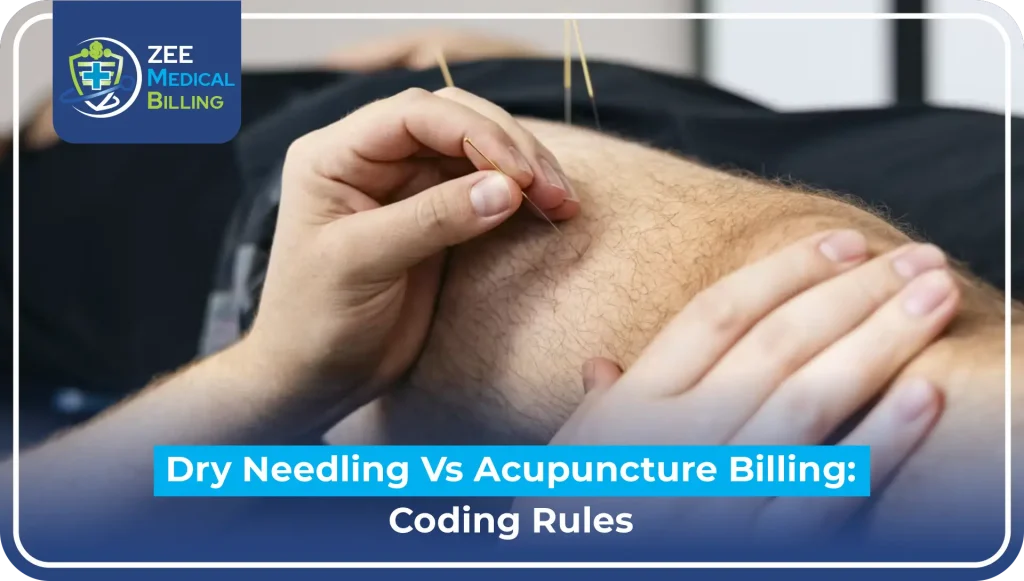
Both procedures put thin needles into muscle tissue. Both treat pain. A patient watching either one would struggle to tell them apart. And yet, in billing terms, they belong to completely separate systems, with different codes, different counting logic, different provider eligibility, and a Medicare policy that treats one as a covered service and the other as non-covered.
The mistakes that follow from blurring them are expensive and specific. One of them involves a modifier that billers reach for instinctively, in a situation where using it is not just ineffective but non-compliant.
This guide lays out exactly how the two code families work, the rules that govern reporting them together, who is permitted to bill which, and the documentation each one demands.
Two Procedures, Two Rulebooks
The clinical distinction matters because the classification follows it.
Acupuncture is rooted in traditional Chinese medicine, uses point selection based on that framework, and is separately licensed in most states. Dry needling, often documented as trigger point dry needling, is a musculoskeletal technique based on modern anatomy and pain science, targeting taut bands and trigger points within specific muscles.
Medicare has been explicit that the two are not interchangeable. Acupuncture received limited Medicare coverage in 2020 for chronic low back pain. Dry needling was classified as a musculoskeletal technique rather than an alternative medicine service, and it went down a different policy path entirely.
For billing teams, the practical translation is simple. These are not two ways to describe the same service. They are two services, and the claim has to pick one.
Also Read: Top 10 Best Acupuncture Medical Billing Service Companies In The USA
The Codes and How They Count
| Factor | Acupuncture | Dry Needling |
| CPT codes | 97810, 97811, 97813, 97814 | 20560, 20561 |
| Counting basis | Time, in 15-minute increments | Number of muscles treated |
| Timed or untimed | Timed | Untimed |
| Code selection driver | Electrical stimulation, then minutes | 1 to 2 muscles versus 3 or more |
| Structure | Base code plus add-on units | Single code per session |
| Supplies | Billed as part of the service | Needles and supplies included in the code |
| Medicare status | Covered for chronic low back pain only | Not covered under the fee schedule |
The counting difference is the one that trips people up most. Acupuncture units accumulate with documented one-on-one contact time, so a longer session can generate more units. Dry needling units do not work that way at all. A forty-minute dry needling session on two muscles is still one unit of 20560. Time is irrelevant to the code selection.
That single structural difference explains why a practice migrating from one code family to the other often gets the unit math wrong in the first month.
Only One Dry Needling Code Per Session
Because 20560 and 20561 are defined by muscle count ranges, they are mutually exclusive.
- 20560 covers one or two muscles.
- 20561 covers three or more muscles.
CMS guidance confirms that only one dry needling code may be reported per session. Submitting both on the same claim triggers an automatic denial because the codes describe overlapping muscle count ranges rather than additive services.
If four muscles are treated, the claim carries one unit of 20561. Not 20560 plus 20561, and not multiple units of 20561. Count the muscles, pick the matching code, report it once.
The Same-Day Rule That Catches Billers Out
Here is the point that deserves the most attention in this article, because the instinctive workaround is the wrong one.
CMS edits prohibit reporting dry needling codes and acupuncture codes for the same date of service. The two procedures are treated as distinct services that should not both appear for a single encounter.
The reflex for many billing teams facing a bundling edit is to append modifier 59 and resubmit. In this specific situation, that is not a fix. Using modifier 59 to unbundle dry needling from acupuncture is considered non-compliant and increases audit exposure rather than resolving the denial.
CPT guidance points in the same direction, instructing that dry needling and acupuncture should not both be coded for one session. A provider licensed to perform both has to determine which service was actually delivered and code accordingly, rather than reporting both and letting a modifier carry the claim.
This also means a practice cannot restructure an appointment to capture both. Splitting a single encounter into two documented services to justify both code families is exactly the pattern a reviewer looks for.
Scope of Practice Decides Who Bills What
Licensure, not technique preference, determines which code family a provider may use.
| Provider Type | Acupuncture Codes | Dry Needling Codes |
| Licensed acupuncturist | Yes, within state scope | Generally no; these describe a different service |
| Physical therapist | No, acupuncture is outside PT scope in most states | Yes, where state practice acts permit dry needling |
| Chiropractor | Only with qualifying acupuncture credentials | Yes, where state law permits |
| Physician, NP, PA | With qualifying acupuncture training for acupuncture codes | Yes, within scope |
Two rules follow from this table.
A therapist performing dry needling cannot bill the acupuncture codes, even when using acupuncture needles. The acupuncture codes require appropriate acupuncture credentials, and acupuncture sits outside physical therapy scope in most states.
An acupuncturist cannot bill acupuncture time under the dry needling codes. Those codes describe trigger point dry needling specifically, not acupuncture performed with a different label.
State variation matters here too. Dry needling remains contested or restricted in some states, and a practice operating across state lines cannot assume uniform authority.
Medicare Treats Them Completely Differently
The Medicare picture is where the gap between the two procedures becomes widest.
For acupuncture, Medicare provides limited coverage for chronic low back pain under a national coverage determination, with defined visit limits and specific provider credential requirements. Every other diagnosis is denied.
For dry needling, CMS assigned the codes a non-covered status for payment under the Physician Fee Schedule. The codes are valid for reporting, which is a different thing from being payable. Medicare will not reimburse dry needling under the fee schedule, and the beneficiary carries financial responsibility.
There is a nuance worth understanding on advance beneficiary notices. An ABN is designed for services Medicare usually covers but might not in a particular case. Because dry needling is non-covered outright rather than conditionally covered, a mandatory ABN is generally not required, and a voluntary notice is the option many practices use for transparency. Guidance in this area has been inconsistent enough that practices report conflicting instructions, so confirming current expectations with your Medicare contractor is worthwhile.
Local contractors have also issued their own policies, which means dry needling coverage handling varies by region even within Medicare. Commercial coverage varies further still, with some plans paying, some excluding dry needling entirely, and some covering it only for defined diagnoses.
Legacy Codes Still Sitting in Some Templates
Before January 1, 2020, dry needling had no dedicated CPT codes. Practices reported using unlisted codes, most commonly the unlisted musculoskeletal procedure code or the unlisted physical medicine and rehabilitation procedure code.
Those approaches are obsolete for dry needling. Dedicated codes now exist, and unlisted codes route claims to manual review while signaling that the practice is working from outdated guidance.
This is worth checking rather than assuming. Code favorites, charge tickets, and superbill templates built before 2020 sometimes still carry the old entries, and nobody notices until a batch of claims stalls.
Modifiers: When 59 Helps and When It Does Not
Modifier 59 has a legitimate role in dry needling billing, and a specific place where it does not belong.
- Where it applies: when dry needling is performed alongside other therapy procedures that trigger an edit, and the services were genuinely distinct. Documentation needs to show separate treatment, separate anatomical sites where relevant, and separate clinical purpose.
- Where it also applies: trigger point injection codes and dry needling codes should not be reported together for the same muscles. When injections are performed on one muscle group and dry needling on a different group during the same session, both may be reportable with modifier 59 and documentation identifying the distinct muscles.
- Where it does not apply: unbundling dry needling from acupuncture. As covered above, that use is non-compliant regardless of how the session was structured.
The broader principle holds here as it does everywhere. Modifier 59 documents a determination that was made clinically. It does not create one.
Also Read: Acupuncture Billing Guide: CPT Codes And Reimbursement
Documentation Each Code Family Requires
The two procedures need genuinely different notes, because the codes are built on different variables.
For acupuncture, the documentation centers on time:
- Actual start and stop times, not a summary of session length
- Minutes of personal one-on-one contact
- Whether electrical stimulation was applied
- Whether needles were re-inserted, which supports the add-on codes
For dry needling, the documentation centers on anatomy:
- Each muscle treated, named specifically and with laterality
- The total muscle count, which determines the code
- The clinical rationale connecting the treatment to the diagnosis
- Symptoms addressed and expected functional outcome
- The patient’s response and any adverse reaction
A dry needling note that says “dry needling performed to the upper back” supports nothing. A note listing right upper trapezius, left levator scapulae, and bilateral rhomboids supports a specific code with a countable justification.
Common Pitfalls Across Both Code Families
At Zee Medical Billing LLC, we often see the same issues surface when practices review denials involving these procedures:
- Reporting dry needling and acupuncture codes for the same date of service
- Appending modifier 59 to force that pairing through
- Billing 20560 and 20561 together on one claim
- Billing multiple units of a dry needling code based on session length
- Therapists reporting acupuncture codes for dry needling services
- Acupuncturists reporting dry needling codes for acupuncture services
- Using pre-2020 unlisted codes for dry needling
- Reporting trigger point injection codes with dry needling codes for the same muscles
- Documenting a general body region instead of named muscles
- Billing Medicare for dry needling without a plan for patient financial responsibility
Most of these come down to one habit: deciding which service was actually delivered before opening the code book, rather than trying to capture both.
FAQs
What is the CPT code for dry needling?
Dry needling is reported with CPT 20560 for needle insertion without injection in one or two muscles, or CPT 20561 for three or more muscles. Both codes have been in effect since January 1, 2020 and are untimed, meaning the code depends on the number of muscles treated rather than session length. Both include the cost of needles and supplies. Before 2020, practices used unlisted codes, and those approaches are now outdated.
Does CPT 20560 need a modifier?
Not automatically. A modifier becomes relevant when dry needling is billed alongside another procedure that triggers an edit and the services were genuinely distinct. Modifier 59 or an appropriate X modifier may apply in that situation, supported by documentation showing separate muscles or a separate clinical purpose. One important limit: modifier 59 should not be used to report dry needling and acupuncture on the same date, since that pairing is prohibited rather than simply bundled.
Does Medicare pay for dry needling?
Generally no. CMS assigned the dry needling codes a non-covered status under the Physician Fee Schedule, so Medicare will not reimburse the service even though the codes are valid for reporting. The beneficiary is financially responsible. Because the service is non-covered outright rather than conditionally covered, a mandatory advance beneficiary notice is generally not required, though many practices issue a voluntary notice for clarity. Local Medicare contractor policies vary, so confirming regional handling is advisable.
Can 20560 and 20561 be billed together?
No. The two codes describe overlapping muscle count ranges, with 20560 covering one or two muscles and 20561 covering three or more. Only one dry needling code may be reported per session, and submitting both triggers an automatic denial. If four muscles are treated, the correct claim is a single unit of 20561. Adding units based on additional muscles or session duration is also incorrect, since these codes are untimed and reported once.
Can a chiropractor or physical therapist bill dry needling codes?
In many states, yes, provided dry needling falls within the provider’s scope of practice under state law and the service is documented appropriately. State practice acts differ, and dry needling remains restricted or contested in some jurisdictions. What these providers cannot do is bill the acupuncture codes for dry needling services, since acupuncture is separately licensed in most states and sits outside physical therapy scope. Confirming state authority before offering the service is the first step.
Conclusion
Dry needling and acupuncture look alike in the treatment room and behave nothing alike on a claim. One counts minutes, the other counts muscles. One has narrow Medicare coverage, the other has none. And the rule against reporting them together is firm enough that the usual modifier workaround makes the problem worse rather than better.
Key takeaways:
- Acupuncture codes count time; dry needling codes count muscles.
- Only one dry needling code applies per session, never both.
- Dry needling and acupuncture should not be reported for the same date of service.
- Modifier 59 does not resolve that pairing and should not be used to attempt it.
- Scope of practice, not technique, determines which code family a provider may bill.
- Medicare covers acupuncture narrowly and does not pay for dry needling.
- Audit pre-2020 templates for unlisted codes that are no longer appropriate.
- Name the muscles treated, with laterality, on every dry needling note.
The practices that avoid trouble here make the determination first and let the coding follow, rather than working backward from what they hope to collect.
.
Follow Us
- Google Map: Zee Medical Billing
- Instagram: @zee_medical_billing
- Facebook: ZeeMedicalBilling
- YouTube: Zee Medical Billing Channel
- Twitter/X: @BillingZee
- LinkedIn: Zee Medical Billing Company
- Pinterest: Zeemedicalbillingllc