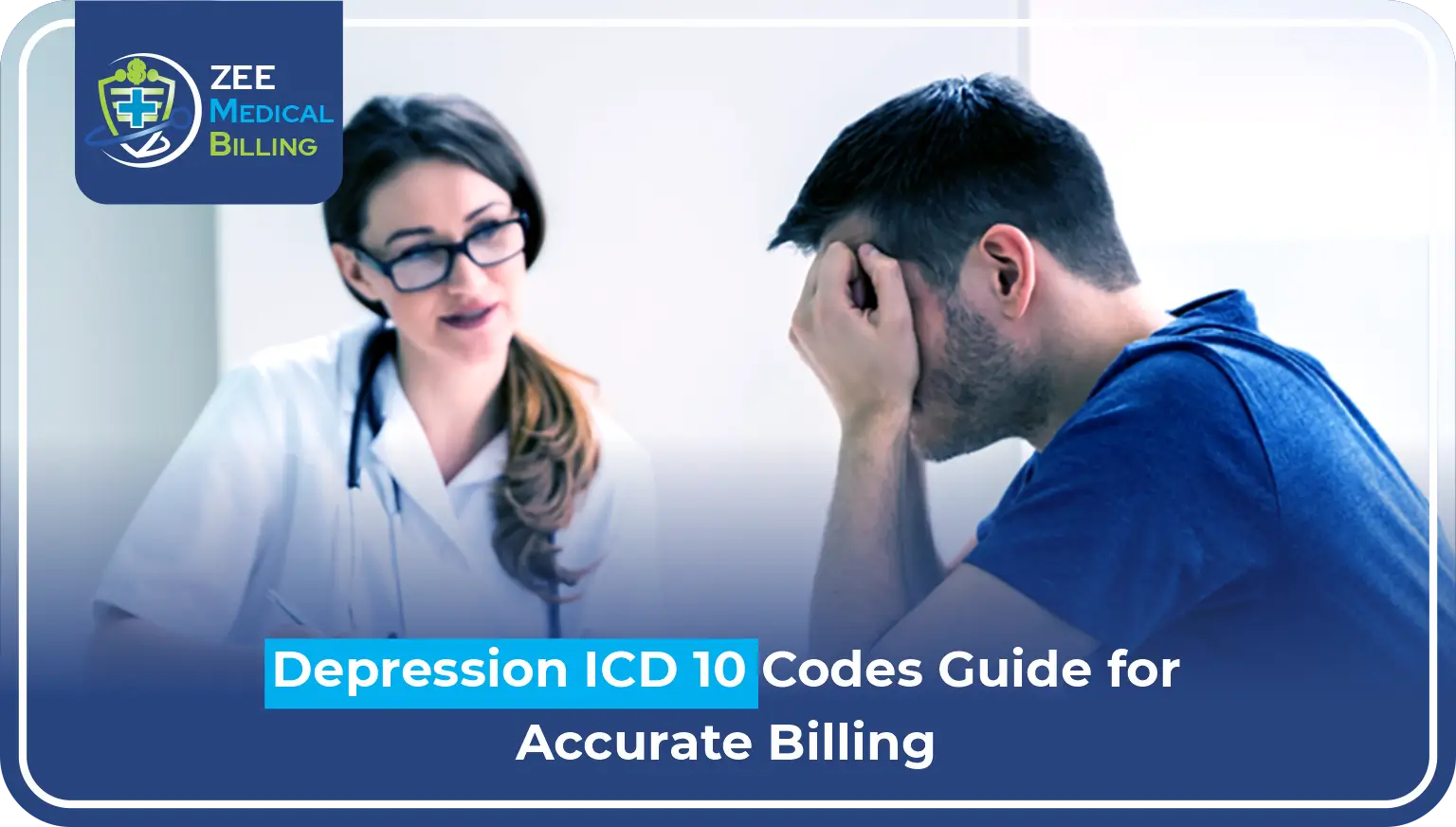
Depression appears in documentation across many settings, including primary care, specialty clinics, OB-GYN, and behavioral health. For billing teams, the hard part is not recognizing the condition. Choosing the right Depression ICD-10 code is hard.
It must match what the provider documented. This helps the claim stay complete, accurate, and compliant.
This guide breaks down how to select the correct ICD 10 code for depression step by step, with common pitfalls to avoid.
Educational disclaimer: This article is for general education only. Coding guidance and payer or state rules can vary and change. Always confirm current ICD-10-CM guidelines and payer policies, and consult qualified professionals when needed.
Why does accurate ICD-10 depression coding matter?
Accurate diagnosis coding supports three practical goals:
- Cleaner claims with fewer edits and denials
- Better medical necessity alignment between the diagnosis and the service
- Less back-and-forth documentation follow-up for providers and staff
Depression coding also intersects with common workflows like screening, care planning, medication management, and postpartum follow-up. That’s why the depression diagnosis code should match what the clinician assessed and treated on that date. You should not base it only on what appears on a past problem list.
Quick ICD-10-CM map for Depression and related concepts
Most depression-related diagnosis coding questions fall into a few common areas:
- Major depressive disorder ICD 10, single episode: F32.0 to F32.9
- Major depressive disorder ICD 10, recurrent: F33.0 to F33.9
- Depression unspecified ICD 10: commonly F32.A (Depression, unspecified)
Related concepts that often appear alongside Depression workflows:
- Depression screening ICD 10: Z13.31 (Encounter for screening for Depression)
- Postpartum depression ICD 10: F53.0 (when documented as postpartum Depression)
- ICD 10 depression with anxiety (mixed anxiety and depressive disorder): F41.2, only when documented as mixed
- Depression with suicidal ideation, ICD 10: suicidal ideation is typically coded separately (for example, R45.851) when assessed and documented
Note on formatting: Many EHRs show codes without decimals. For example, the f331 diagnosis code often refers to F33.1, and the f33.9 diagnosis code refers to F33.9. Always submit the standard ICD-10-CM format required by your payer and clearinghouse.
Step by step: how to choose the right Depression ICD 10 code
Use this workflow whenever you are selecting an ICD 10 code for Depression.
Step 1: Confirm what the encounter was for
Start with visit intent. Was the encounter primarily:
- Screening only (no diagnosis established or managed today)
- Evaluation and diagnosis
- Ongoing management or follow-up
- History review only (past Depression, not actively addressed)
If the visit was only screening, a screening for Depression ICD 10 code like Z13.31 may be appropriate. If the note documents active assessment or management of Depression, use an active depression ICD 10 code.
Common pitfall: Using a screening code when the note clearly documents treatment or management. Or, using an active depression diagnosis when the visit was only for screening.
Step 2: Identify whether the provider documented MDD or only “depression”
Many claim issues happen because teams default to major depressive disorder ICD-10 codes without a clear diagnosis statement.
Ask:
- Does the assessment explicitly state major depressive disorder (MDD) or major Depression?
- Or does it only state Depression, depressive disorder, depressed mood, or similar language?
If the note doesn’t document MDD and only says depression, use an ICD-10 code for depression. Depression unspecified may apply, often F32.A, based on your policies and payer rules.
Important distinction: Depression, unspecified, is not the same as MDD, unspecified. If the provider documents MDD but does not state severity, you usually stay in the MDD code family. Do not switch to F32.A.
Step 3: If MDD is documented, decide single episode vs recurrent
This decision drives the correct family for the icd 10 code for major depressive disorder.
- Single episode MDD: typically coded within the F32 family
- Recurrent MDD: typically coded within the F33 family
Documentation clues for recurrent major depressive disorder icd 10:
- “Recurrent” was stated in the assessment
- Prior episodes described
- Structured diagnosis lists MDD recurrent
If the record does not say whether it is a single event or a recurrence, and the difference matters, ask the provider.
Step 4: Capture severity only when it is documented
Severity changes code selection inside both MDD families.
- Mild depression ICD 10: use mild options when documented
- Moderate depression ICD 10: Use moderate options when documented
- Severe depression ICD 10: use severe options when documented
Practical examples of common searches and what they often refer to:
- Icd 10 mdd / MDD ICD-10 / icd 10 for MDD: usually points to F32 or F33, depending on single vs recurrent
- Major Depression, recurrent icd 10: usually points to the F33 family
- f331 diagnosis code: commonly points to recurrent MDD, moderate (F33.1)
- f33.9 diagnosis code: commonly points to recurrent MDD, unspecified (F33.9)
Common pitfall: Assigning severity solely from a PHQ-9 score when the provider did not document severity. Coding should follow the provider’s documented diagnosis and plan.
Step 5: Check for psychotic features (only if documented)
If the provider documents “with psychotic features,” code within the appropriate MDD options.
Common searches you may see:
- MDD with psychotic features, icd 10
- depression with Psychotic Features, ICD-10
Do not apply psychotic feature coding unless the clinician explicitly documents it.
Also Read: Complete List Of GERD ICD-10 Codes You Need To Know
Step 6: Use remission status only when clearly documented
Remission status can change code selection. You may see searches like Depression in remission icd 10 or Major Depression in remission icd 10. Apply remission coding only when the clinician documents remission status in the assessment.
Common pitfall: Coding remission while the note documents ongoing symptoms, active medication changes, or safety concerns.
Step 7: Depression with anxiety: separate diagnoses vs mixed disorder
When teams search “ICD-10 code for depression with anxiety” or “ICD-10 depression with anxiety,” they usually need help. They often face one of these scenarios.
Scenario A: Two separate diagnoses are documented
- Example: MDD plus an anxiety disorder. If you document and address both, you may code both appropriately.
Scenario B: Mixed anxiety and depressive disorder is documented
- If the note explicitly states mixed anxiety and depressive disorder, F41.2 may be appropriate.
Compliance notes: Do not assume “mixed.” Write code that matches the documentation.
Step 8: Postpartum Depression and postpartum mood disturbance are different
Postpartum documentation needs careful matching.
- If the assessment states postpartum Depression, postpartum depression ICD 10 is commonly F53.0.
- If the assessment states postpartum mood disturbance or postpartum blues, code the documented diagnosis and follow the related guideline.
If documentation is unclear, query rather than guessing. Postpartum rules can be payer sensitive.
Step 9: If bipolar Depression is documented, avoid MDD codes
A frequent denial driver is coding MDD when the assessment is bipolar disorder with a current depressive episode.
Common searches:
- icd 10 code for bipolar Depression
- bipolar with Depression icd 10
- manic Depression icd 10
If the documentation lists bipolar disorder, code it in the bipolar family. Follow the documentation and guidelines. Do not code it in the MDD families.
Step 10: Add screening or symptom codes only when they truly apply
Two common add-ons:
- Depression screening: Z13.31 applies to screening encounters.
- Suicidal ideation: You may code it when you assess and document it.
Because suicidal ideation is sensitive, make sure documentation is clear and complete. Do not code it unless the documentation specifically requires it.
High confusion area: F32.A vs F32.9 vs F33.9
These codes are often mixed up because they all look “unspecified,” but they represent different documentation realities.
- F32.A (Depression, unspecified): The record documents depression, but it does not document MDD.
- F32.9 (MDD, single episode, unspecified): The documentation indicates one episode of MDD, but it does not specify the severity.
- F33.9 (MDD, recurrent, unspecified): The record documents recurrent MDD, but it does not specify severity.
If the provider documents major depressive disorder, and you submit ICD-10 F32Forr depression unspecified, payers may flag it.
Also Read: Skin Tag ICD-10 Codes And CPT Guide For Easy Billing
Where does “chronic depression” commonly fit?
Many people search for chronic depression ICD-10 when symptoms are long-lasting. In practice, documentation may refer to persistent depressive disorder, also called dysthymia. It may still list MDD as single episode or recurrent. Coding should follow the provider’s documented diagnosis. When the record is unclear, a provider query is often safer than guessing.
Comparison table 1: single episode vs recurrent MDD
| Documentation language | Typical family | Practical billing meaning |
|---|---|---|
| Major depressive disorder, single episode | F32- | First documented major depressive episode, with severity options |
| Major depressive disorder, recurrent | F33- | Multiple episodes, with severity and remission options |
| MDD was stated, but single vs recurrent was not stated | F32- or F33- depends | Often needs a provider query or an allowable unspecified choice |
| Depression documented, but MDD not stated | F32.A often | Depression without enough detail to classify as MDD |
Comparison table 2: common claim scenarios and risks
| Scenario in the note | Code concept to consider | Common claim risk if mismatched |
| Preventive or annual visit includes PHQ-9 only, no diagnosis made | Z13.31 depression screening icd 10 | Denial, if coded as active treatment without documentation |
| “Depression, unspecified” documented | F32.An ICD-10 code for depression, unspecified | Payer edits if documentation supports MDD |
| “MDD, recurrent, moderate” documented | F33.1 (f331 diagnosis code) | Downcoding or denial if the severity is not supported |
| “MDD, recurrent, unspecified” documented | F33.9 (f33.9 diagnosis code) | Scrutiny for vague coding when severity is documented |
| “Mixed anxiety and depressive disorder” documented | F41.2 icd 10 depression with anxiety | Denial is used when two separate diagnoses were documented |
| “Postpartum depression” documented | F53.0 postpartum depression icd 10 | Denial if the postpartum diagnosis context is not supported |
Documentation checklist for billing and A/R teams
Use this checklist to validate that the ICD-10 depression selection matches the record.
- Clear diagnosis statement (Depression, MDD, bipolar disorder, persistent depressive disorder, mixed anxiety and Depression)
- Episode status for MDD (single episode vs recurrent)
- Severity (mild, moderate, severe) if documented
- Psychotic features, if documented
- Remission status is documented.
- Screening vs management (screening code vs active diagnosis code)
- Postpartum context, when applicable
- Risk symptoms assessed (only if documented)
At Zee Medical Billing LLC, we often see denials when documentation supports a specific MDD subtype. Still, the claim is submitted with an unspecified depression ICD-10 code. Or a screening visit is coded as active treatment without supporting documentation.
Common pitfalls that cause denials or rework
Overusing unspecified codes
Unspecified codes are sometimes appropriate, but frequent unspecified coding can trigger payer review, especially when documentation supports more detail.
Examples:
- Submitting F32.When the provider documented MDD
- Using F33.9 when “recurrent, moderate” was documented
Confusing “situational depression” with other diagnoses
- “Situational depression” is a common phrase, but the documented diagnosis may be an adjustment-related condition rather than MDD. Write code that matches the documentation.
Coding bipolar Depression as MDD
- Suppose the assessment is bipolar disorder with a depressive episode; code bipolar disorder per documentation. Do not use MDD codes.
Using screening scores as the diagnosis
- PHQ-9 and other tools support clinical assessment, but diagnosis coding should follow the provider’s documented diagnosis and plan.
Adding sensitive symptom codes without support
- Suicidal ideation should only be coded when assessed and documented. If documentation is incomplete, clarify before coding.
Practical examples (generic)
These simplified examples are illustrative only.
- Example A
- Documentation: “Depression, unspecified. Discussed sleep and follow-up.”
- Coding concept: Depression unspecified ICD 10 (often F32.A) if MDD is not documented.
- Example B
- Documentation: “Major depressive disorder, recurrent, moderate. Medication adjusted and follow-up planned.”
- Coding concept: MDD recurrent moderate (often F33.1, searched as icd 10 code for MDD and F331 diagnosis code).
- Example C
- Documentation: “Encounter for depression screening. PHQ-9 completed. No diagnosis made today.”
- Coding concept: Z13.31 (icd 10 code for depression screening).
FAQs
What is the most common ICD 10 code for Depression?
No single “most common” code fits every visit. Many teams search “Depression ICD-10” and choose an unspecified code.
But the correct depression ICD-10 code depends on the documentation. If the note only states Depression without stating MDD, depression unspecified icd 10 (often F32.A) may fit. If the provider documents major depressive disorder, use the correct MDD code family.
- Use F32- for a single episode.
- Use F33- for recurrent episodes.
Apply severity levels or specifiers only when documentation supports them.
What is the difference between Major Depressive Disorder, ICD-10, and Depression Unspecified, ICD-10?
- Providers use major depressive disorder ICD-10 codes when they document MDD.
- Ideally, the provider also includes episode status and severity. Depression, unspecified, ICD 10 generally applies when the provider documents depression but does not document MDD.
- Using ‘Depression, unspecified’ when the note clearly states MDD can create a mismatch and prompt payer questions.
How do I code Depression with anxiety in ICD-10?
Start with documentation. If the provider documents two separate diagnoses, coding both may be appropriate. For example, MDD and an anxiety disorder. Both must be supported and addressed. If the provider documents mixed anxiety and depressive disorder, F41.2 may be appropriate. Avoid assuming “mixed” if it is not documented.
What ICD-10 code do clinicians use for postpartum depression?
If the provider documents postpartum depression, postpartum depression icd 10 is commonly F53.0. If documentation instead states postpartum mood disturbance or postpartum blues, coding follows that documented diagnosis context. Because postpartum coding can be payer-sensitive, confirm payer policy and ensure documentation supports the timing and diagnosis.
Can I bill a depression screening with an active depression diagnosis?
What happened in the encounter and what you document determine the outcome. Z13.31 (Depression screening icd 10) is intended for screening encounters. If the visit is clearly for ongoing management of an established condition, use the active depression diagnosis code. If you use a screening tool during ongoing care, use the diagnosis code for the condition assessed or treated. Your documentation should also support medical necessity for billed services.
Conclusion
Accurate ICD-10 coding for depression is about consistent, documentation-first decisions. Confirm whether the encounter was screening or active management, match the record to the correct family (MDD single episode, MDD recurrent, or depression unspecified when MDD is not documented), and capture severity, psychotic features, remission, postpartum status, and anxiety overlap only when clearly documented.
Also, avoid common denial drivers like coding bipolar depression as MDD or using screening codes for active treatment visits. When coding aligns with the documented clinical story, claims are cleaner, compliance risk is lower, and rework drops.
.
Follow Us
- Google Map: Zee Medical Billing
- Instagram: @zee_medical_billing
- Facebook: ZeeMedicalBilling
- YouTube: Zee Medical Billing Channel
- Twitter/X: @BillingZee
- LinkedIn: Zee Medical Billing Company